Category: Goals

  • How to Align Your Daily Work with Big Goals Using AI

    How to Align Your Daily Work with Big Goals Using AI

    Here’s a scenario most managers know well. Quarter-end arrives. Someone pulls up the OKR dashboard, and the numbers look fine. But when they actually trace what the team spent its time on for the past three months, there’s a quiet, uncomfortable realization: a lot of that work had nothing to do with the goals that were supposed to matter.

    This isn’t a discipline problem or a motivation problem. It’s an alignment problem. And it’s more common than anyone likes to admit.

    The disconnect between what people actually do each day and what the business is trying to achieve is one of the most expensive inefficiencies in knowledge work. Goal-setting frameworks like OKRs and KPIs are supposed to solve this. But most of them are set at the beginning of a quarter, filed somewhere, and then completely disconnected from the task management tools where real work happens.

    The result? Goal fatigue. Teams that feel busy but not purposeful. Managers who spend half their week in status meetings trying to manually reconnect the dots.

    AI is starting to close that gap. Not by adding another reporting layer, but by working inside the tools where work actually happens and surfacing alignment or the lack of it in real time.

    Why Connecting Daily Work to Company Goals Is So Hard

    Strategic goals tend to live in one place. Daily tasks live somewhere else entirely. In most organizations, those two worlds rarely talk to each other except during quarterly reviews, sprint planning, or when something goes visibly wrong.

    There’s a structural reason for this. Goals are typically set top-down, framed in high-level language (“increase client retention by 15%”), while tasks are created bottom-up, framed in operational language (“update onboarding deck”, “fix billing bug”, “send follow-up to key account”). Bridging those two vocabularies has always required a human to do it manually, in a meeting, on a recurring basis.

    The research is unambiguous on the cost. According to a Gallup study on employee engagement, only 26% of employees strongly agree that their manager’s feedback helps them do their job better. The implication is telling: most contributors are navigating daily work without a reliable, real-time signal of whether what they’re doing actually connects to what matters.

    The cost compounds at scale. McKinsey research found that employees who feel their daily work connects to a broader purpose are four times more likely to report high engagement than those who don’t. That’s not a wellbeing metric, it’s a productivity and retention metric. When people can’t see how their daily tasks align to OKRs and company goals, they disengage. And disengagement is far more expensive than the hour it would take to surface that connection clearly.

    AI doesn’t eliminate this challenge, but it changes the economics of solving it. Instead of requiring a human to manually trace task-to-goal connections once every two weeks, an AI-powered system can do it continuously, in the background, and surface the gaps before they compound.

    “Most strategy failures aren’t failures of strategy. They’re failures of execution specifically, failures to translate strategy into the daily decisions and behaviors of people doing the work.” – Roger Martin, former Dean, Rotman School of Management

    That gap between strategy and daily behavior is exactly where AI goal alignment tools are now operating.

    What AI Goal Alignment Actually Means in Practice

    When most people hear “AI goal alignment”, they imagine a dashboard with a health score and some colour-coded indicators. That’s part of it, but it’s the surface layer.

    The more meaningful version works like this: your tasks, projects, and logged time are continuously analyzed against your stated goals. The system identifies which tasks are actively contributing to which objectives, which goals have had no associated activity for several days, and where time is being spent on work that doesn’t map to any strategic priority at all. Done well, this is goal tracking with AI built into the rhythm of work, not bolted on top of it.

    Done well, this creates three practical capabilities that most teams don’t currently have:

    • Real-time alignment scoring. Instead of finding out at quarter-end that a goal was neglected, you get a signal mid-sprint. There’s still time to course-correct.
    • Automated progress context. Status updates and check-ins become much shorter because the data is already surfaced. You’re discussing decisions, not compiling reports.
    • Prioritization signals. When an AI assistant can see that your highest-weighted goal has had zero task activity in five days, it can surface that as a recommendation  not just a warning light, but actionable context.
    💡 Pro Tip: Alignment scoring is only useful if the original goals are well-defined. Vague OKRs like “improve team culture” produce vague alignment signals. The more specific and measurable your goals, the more actionable your AI’s output will be.

    A Practical Workflow to Align Tasks to OKRs Using AI

    The following workflow is designed for individual contributors and mid-level managers who want to connect daily work to company goals without adding more overhead to their week.

    Step 1: Set goals in the same system where work happens

    This is the most overlooked prerequisite. If your goals live in a slide deck or a separate OKR tool that doesn’t talk to your task manager, no amount of AI can help. The first move is consolidating your goal structure into your work management platform so the AI has something to compare tasks against.

    The goal definition doesn’t need to be elaborate. A clear objective, a measurable outcome, and a timeframe is enough.

    Step 2: Tag or link tasks to goals as you create them

    Most modern work management platforms let you associate a task with a project, initiative, or goal. This step is low-friction once it becomes habit, but it’s the data input the AI depends on. Think of it like categorizing expenses, you only have to do it once per task, and the system does the analysis from there.

    💡 Pro Tip: If tagging every task feels like overhead, start with only your top three priorities for the week. Link those tasks to goals and let the AI surface patterns from that subset. You can expand coverage once the habit is established.

    Step 3: Use your AI assistant for daily prioritization, not just status

    This is where the shift in value happens. Most people use AI assistants to generate summaries or answer questions about completed work. The more powerful use is asking it forward-looking questions at the start of each day.

    Questions like: “What’s my highest-priority goal this week and which tasks are currently supporting it?” or “Is there any active goal that hasn’t had any task activity in the past three days?” These aren’t complicated prompts, but they produce a very different kind of morning review.

    Step 4: Review alignment weekly, not quarterly

    A quarterly goal review is too slow. By the time misalignment surfaces, you’ve often lost six weeks of momentum. A weekly review of goal-to-task alignment  which should take under ten minutes with a system that surfaces it automatically, keeps strategy and execution close enough to be correctable.

    The weekly review doesn’t need to be a meeting. It can be a two-minute scan of your AI-generated alignment summary, followed by a few task adjustments.

    Step 5: Let AI handle the reporting, so you can handle the work

    One of the most draining parts of any management role is translating operational activity into strategic language for stakeholders. AI-assisted goal alignment automates a significant portion of this, particularly the “here’s what we did and here’s how it connects to our objectives” layer of status reporting.

    When your system already knows which tasks are mapped to which goals, and how much time was invested, generating a meaningful weekly or fortnightly update becomes a query rather than a manual effort.

    📋  In Practice: What This Looks Like A mid-level manager at a professional services firm has a client retention goal marked as high-priority for the quarter. It’s Wednesday afternoon. The week’s task board is full internal admin, a backlog of bug fixes, a few proposal edits. None of it maps to retention. Without an alignment system, this doesn’t surface until the Friday status call, or the end-of-sprint retrospective, or the quarterly review. By then, a week’s worth of capacity has been misallocated. With AI goal tracking built into the work management platform, the system flags the mismatch on Tuesday evening: “Client Retention (Q2 priority) has had no active task coverage since Monday. Three tasks currently in progress are unlinked to any goal.” The manager sees it before Wednesday’s standup. One conversation, two task reassignments, and the week is back on strategy. The AI didn’t make the decision. It just made the misalignment visible early enough to do something about it.

    Where Most Teams Get This Wrong

    The failure mode we see most often isn’t a technology failure. It’s a habits failure. Teams adopt a goal alignment tool, spend two days configuring their OKRs, and then go back to creating tasks the same way they always did  without linking them to anything.

    The result is an AI that has beautifully structured goals and no task data to analyze. It’s like setting up an analytics platform and forgetting to install the tracking code.

    The other common mistake is expecting AI to replace goal clarity. If the goals themselves are vague, competing, or unstated, the alignment system will faithfully reflect that confusion back at you. Garbage in, garbage out applies here. The AI is a signal amplifier, not a strategy consultant.

    💡 Pro Tip: Before implementing any AI goal alignment system, spend 30 minutes auditing your current goals for specificity. If you can’t measure progress against a goal without a meeting, rewrite it first. The AI will do the rest.

    That clarity is what goal tracking with AI is ultimately trying to give back to people doing complex, high-stakes work.

    Why the System Has to Be Unified to Work

    Here’s the design principle that most goal alignment tools miss: the AI is only as good as the data it can see. And in most organizations, the data is fragmented across a task tool, a goal-tracking sheet, a time management app, and a project management platform that don’t share a common data layer.

    When goals and tasks live in separate systems, alignment requires a human bridge, a meeting, a manual update, a copied-and-pasted status report. That’s the bottleneck. No AI overlay fixes a fragmentation problem; it just adds another layer on top of the same broken structure.

    The teams that actually close the gap are the ones who consolidate: goals, tasks, projects, time, and resources in one environment. When the AI can see all of that at once, surfacing the kind of mismatch in the scenario above stops being a report and starts being a reflex.

    This is the architecture Skarya was built around. Kobi, Skarya’s AI work assistant, doesn’t sit outside the work; it operates inside the same environment where tasks are created, time is logged, and projects move. That means it can flag that a high-priority goal has no active task coverage, identify where hours are being spent on work that doesn’t connect to any stated objective, and generate progress context automatically rather than waiting for someone to compile it.

    The My Day module gives individual contributors a daily view shaped by both their task list and their goal commitments. The CFO Dashboard surfaces the financial and operational picture for leaders who need to see how execution maps to investment. Neither requires manual assembly, they’re generated from the same live data.

    If this is the kind of alignment problem your team is dealing with, see how your team connects daily execution to big-picture goals.

    The Bottom Line

    Goal alignment has always been hard because it requires two fundamentally different types of thinking, strategic framing and operational execution, to stay in constant conversation. That conversation has historically happened in meetings, and meetings are expensive and slow.

    AI doesn’t replace thinking. But it does replace the manual work of translating between the two layers. That’s not a small improvement. For any team that has ever arrived at a quarterly review and wondered where three months went, it’s the kind of change that compounds.

    The teams that move fastest won’t have the best goals. They’ll be the ones who never have to wonder, on a Wednesday afternoon, whether the work in front of them is pointed at anything that matters.

    Frequently Asked Questions

    What is AI goal alignment?

    AI goal alignment refers to using artificial intelligence to automatically map daily tasks, time, and project activity to your stated strategic goals  identifying gaps, surfacing progress, and prioritising work in real time without manual reporting.

    How does AI help with OKR tracking?

    AI-powered OKR tracking connects task-level activity to high-level objectives continuously, rather than waiting for end-of-sprint reviews. It can flag when a key result has had no associated task activity, generate progress summaries automatically, and surface which goals are at risk of under-investment.

    What’s the difference between a goal alignment tool and a task manager?

    A task manager helps you organize and complete individual tasks. A goal alignment tool maps those tasks to strategic outcomes and measures whether daily activity is actually moving the business forward. The most effective approach is connecting daily work to company goals within a single unified system.

    Can AI replace quarterly goal reviews?

    Not entirely, but it can dramatically reduce their frequency and duration. When alignment is tracked continuously and progress is surfaced automatically, quarterly reviews become strategic conversations rather than data-gathering exercises. Most teams using AI-assisted goal alignment shift to monthly check-ins rather than quarterly ones.

    How do you get a team to actually link tasks to goals?

    Start small. Ask the team to link only their top three weekly priorities to goals. Once the habit is established and they can see the benefit, specifically, that status reporting becomes faster, adoption typically spreads naturally. The key is making sure the friction of linking a task is lower than the friction of the status meeting it replace


  • Time Management Myths That Are Wasting Your Day

    Time Management Myths That Are Wasting Your Day

    You’ve read the articles. You’ve downloaded the apps. You’ve color-coded the calendar, blocked the mornings, and set the intentions. And somehow, the day still slips through your fingers.

    The problem might not be your discipline. It might be the advice.

    A lot of popular time management guidance sounds compelling especially when it’s delivered confidently by someone with a best-selling book. But good marketing isn’t the same as good evidence. Some of the most widely shared productivity tips are, at best, oversimplifications. At worst, they’re actively making things harder.

    Here are six common time management mistakes hiding in plain sight, dressed up as best practice, repeated in workplaces and self-help bestsellers alike, and what actually holds up when you look more carefully.

    The Advice Is Everywhere. The Results Aren’t.

    Search “productivity tips” and you’ll get millions of results: morning routines, time-blocking templates, habit stacks, focus frameworks. All of it confident. Most of it contradictory.

    What’s missing isn’t more advice. It’s honest scrutiny of the advice that already exists.

    None of the myths below are fringe ideas. They’re mainstream recommendations  the kind that get repeated in team meetings, performance reviews, and keynote talks. They persist not because they work, but because they feel like they should. That’s exactly what makes them worth examining.

    Myth #1- You Just Need a Better To-Do List

    The to-do list is the cornerstone of most productivity systems. And for many people, it’s also a quiet source of anxiety disguised as organisation.

    The problem isn’t writing things down that’s genuinely useful. The problem is treating a list as a plan. A to-do list tells you what exists. It doesn’t tell you what matters, what’s realistic for today, or what you should stop doing entirely.

    There’s a well-documented psychological phenomenon called the Zeigarnik Effect,  the tendency for incomplete tasks to occupy working memory even when you’re not actively engaged with them. The original research, conducted by Soviet psychologist Bluma Zeigarnik in the 1920s and revisited extensively since, suggests that the mere existence of open loops creates cognitive tension. A list of 40 items doesn’t organize your attention. It fragments it.

    More items rarely mean more progress. They usually mean more background noise.

    “What gets scheduled gets done. What merely gets listed gets postponed.”

    Pro Tip  Before adding to your list, subtract from it. Write a “not-to-do list”, the low-value tasks, the reflex commitments, the things you keep rolling over that don’t actually need to exist. Removing three things often frees more mental space than any new scheduling technique.

    Myth #2 -Waking Up at 5am Makes You More Productive

    This one has a remarkable grip on the business world. Win the morning, win the day.

    The 5am narrative is genuinely compelling  but it rests on a flawed assumption: that there’s a universally optimal time to do deep work, and it happens to fall before sunrise.

    Chronobiology complicates that picture. Researcher Till Roenneberg, whose large-scale work on human sleep patterns at Ludwig Maximilian University of Munich has tracked chronotypes across hundreds of thousands of people, found that biological sleep timing varies significantly across the population,  and that a meaningful proportion of adults are genetically wired to function better later in the day. Forcing a late chronotype into a 5am schedule doesn’t unlock hidden performance. It accumulates sleep debt.

    The real principle buried inside the early-rising myth is worth keeping: protecting your highest-energy hours for your most demanding work matters. For some people that’s 6 am. For others it’s 10 am or 2 pm. The hour is less important than the habit of protecting it.

    “You can discipline yourself to wake up earlier. You can’t discipline your circadian rhythm out of existence.”

    Pro Tip  For one week, track your energy alongside your tasks, note when you feel sharpest versus when you’re running on inertia. The pattern is usually clearer than expected. Build your schedule around it, not around what productivity influencers do at dawn.

    Myth #3- Multitasking Is a Skill Worth Having

    It gets listed on CVs. It gets praised in job interviews. It isn’t real.

    What we call multitasking is task-switching,  moving attention rapidly between two or more things. The cognitive cost is well-established.

    Researchers at the American Psychological Association, synthesizing findings across multiple studies, found that switching between tasks introduces a “switch cost”. a lag in cognitive performance that compounds as tasks become more complex. The cumulative productivity loss is substantial, with some estimates placing it at 20–40% depending on task type and frequency of switching.

    The mechanism matters here: every time you switch, a residue of the previous task stays active in working memory. You’re not thinking about two things. You’re thinking about one thing badly while the other one lingers.

    The people who appear to multitask well have usually done something different batched similar tasks together, reduced the number of active decisions in their environment, or built structures that minimise interruptions. That’s not multitasking. It’s the opposite of it.

    Pro Tip  When you notice yourself switching between tasks, add a 60-second re-entry ritual before each new one — close the previous tab, write a single sentence capturing where you left off, then begin fresh. Small friction. Significant cognitive difference.

    Myth #4- Busy Means Productive

    This is probably the most culturally embedded bad productivity habit on this list and the hardest to argue against, because it’s woven into how many workplaces signal value.

    Busyness has become a status marker. Say you’re busy and people hear: important, in-demand, indispensable. But busyness and productivity measure completely different things. Productivity asks what moved forward. Busyness asks how full the day felt.

    You can have a packed calendar and reach Friday with nothing meaningful advanced. Meetings that could have been emails. Emails that didn’t need replies. Tasks completed thoroughly that didn’t need to exist at all.

    For many professionals and teams, the real problem isn’t lack of effort, it’s lack of visibility into which work actually creates value versus which work just generates motion. That distinction is harder to make than it sounds, especially in environments where activity is visible and impact isn’t.

    That’s the kind of operating clarity platforms like Skarya.ai are designed to support, not adding more structure on top of a busy day, but building the shared understanding of priority that makes the right work easier to identify and protect.

    “Don’t mistake movement for progress.”

    The honest question at the end of each day isn’t “Was I busy?” It’s “Did the right things move?”

    Myth #5- You Need to Work Longer to Get More Done

    More hours should produce more output. The equation is intuitive. Past a certain threshold, it breaks down.

    In a frequently cited 2014 study, Stanford economist John Pencavel analysed output data from British munitions workers during World War I and found that output per hour declined sharply once workers exceeded around 49 hours per week  and that working 70 hours produced roughly the same total output as working 55. The extra 15 hours were, in terms of actual results, largely wasted.

    The health dimension reinforces this from a different angle. A large meta-analysis published in The Lancet in 2015, drawing on data from over 600,000 individuals across Europe, the US, and Australia, found that working 55 or more hours per week was associated with meaningfully higher risk of cardiovascular events compared to standard working hours.

    The compounding issue isn’t just diminishing returns. It’s that sustained overwork degrades the quality of rest, which degrades the quality of the working hours themselves. Recovery isn’t a productivity tax. It’s what makes sustained focused effort possible.

    Pro Tip  Set a hard stop time and treat it like a non-negotiable meeting. Not “I’ll finish when this feels done” a fixed time. The constraint forces prioritization in ways that open-ended sessions rarely do.

    Myth #6-The Right App Will Fix Your Time Problem

    Every few months, a new productivity app promises to change everything. Every few months, people download it with genuine enthusiasm, use it for two weeks, and quietly return to their previous habits slightly more guilty, slightly more sceptical.

    Apps don’t fix time management problems. They amplify whatever system or absence of system already exists. Give a disorganized workflow a new tool and you get disorganized data in a better-looking interface.

    This isn’t an argument against tools. The right tool, inside a working system, genuinely helps. But the sequence matters: system first, tool second. Get clear on how you want to work, what you’re protecting, what you’re batching, how you’re triaging and then find something that supports that. Choosing the tool first and hoping it reveals the system is why the graveyard of abandoned productivity apps is so crowded.

    Pro Tip  Before adopting any new tool, write down two things: the specific problem it solves, and how you’ll know in 30 days whether it’s working. If you can’t answer both, the problem isn’t the tool — it’s that the system isn’t defined yet.

    What Actually Works

    Every myth on this list shares the same underlying failure: they focus on tactics while skipping the harder question of strategy. They tell you how to organise your time without ever asking why you’re spending it the way you are.

    Better time management doesn’t come from a stricter system. It comes from answering three questions most productivity advice never asks:

    What actually matters? Not what’s on the list, not what arrived loudest in your inbox what genuinely moves something important forward.

    What can wait? Not everything urgent is important. Not everything scheduled is necessary. The ability to defer without guilt is a skill, not a weakness.

    What should disappear entirely? The most underrated time management move isn’t prioritization. It’s elimination. The tasks, meetings, and commitments that consume time without creating value don’t need to be managed better. They need to be gone.

    Time management gets better when you stop asking “How do I fit more in?” and start asking those three questions honestly. The schedule takes care of itself from there.

    If this resonates and you’re thinking about it as a team challenge not just a personal one see how Skarya.ai approaches priority and visibility.

    FAQ

    Why doesn’t the Pomodoro Technique work for everyone?

    The Pomodoro method works well for tasks that can be meaningfully broken into short, contained bursts. For complex analytical work or deep creative projects, the fixed 25-minute interruption can break flow rather than build it. The underlying principle protecting focused time  is sound. The rigid structure doesn’t fit every type of work or every person’s concentration pattern. Adjusting the interval (to 50 or 90 minutes, for example) often preserves the benefit without the friction.

    Is time blocking actually effective, or is it another productivity myth?

    Time blocking works  but only when blocks are realistic and actively protected. The most common failure mode is an over-scheduled day with no buffer, which collapses the moment anything unexpected happens. Effective time blocking leaves roughly 20–30% of the day unallocated, treats the schedule as a guide rather than a contract, and includes a short weekly review to adjust. Without those safeguards, it becomes just another elaborate to-do list.

    What are the most common time management mistakes people don’t realize they’re making?

    The three that show up most consistently: treating a full calendar as evidence of productivity, optimising for the wrong hours based on someone else’s routine rather than their own energy patterns, and adopting new tools before the underlying system is clear. The last one is particularly common — and particularly expensive in terms of time spent managing the tool rather than the work.

  • SMART Goals: How to Turn a Wish Into a Plan

    SMART Goals: How to Turn a Wish Into a Plan

    Most goals fail before they even start. Not because of a lack of ambition, but because the goal was never clear enough to act on.

    “Improve team performance.” “Grow revenue.” “Get more organized.” These sound like goals. They feel like goals. But they are wishes, not plans.

    SMART goals are goals designed to be Specific, Measurable, Achievable, Relevant, and Time-bound, so they are easier to plan, track, and complete.

    The SMART framework exists to close the gap between intention and execution. Whether you are a manager setting quarterly targets, a team lead aligning your squad around shared outcomes, or an individual trying to move a project forward, SMART goals turn ambiguity into action.

    What Are SMART Goals?

    SMART is an acronym. Each letter defines a quality that a well-written goal should have. Together, the five criteria turn a vague direction into something concrete you can assign, schedule, and track.

    SSpecificWhat exactly needs to happen? Name it clearly.
    MMeasurableHow will you know you’ve hit it? Attach a number.
    AAchievableIs this realistic given your current capacity and constraints?
    RRelevantDoes this goal connect to what actually matters right now?
    TTime-boundWhen does it need to be done? Open-ended goals rarely get done.

    Why SMART Goals Work

    In practice, clear goals tend to outperform vague ones because people know what they are trying to achieve and exactly how progress will be measured. There is less room for misinterpretation, less wasted effort on the wrong things, and fewer conversations that end with everyone nodding but no one knowing what happens next.

    For teams specifically, this matters more. When goals are clear, ownership is easier to assign. When ownership is clear, accountability follows naturally. And when everyone can see the same target, alignment stops being a management problem and starts being a natural byproduct of the work.

    How to Write SMART Goals: Letter by Letter

    Here is how to apply each criterion in practice, including what a weak goal looks like and what a sharper version looks like instead.

    S: Make it Specific

    Specific means naming what will change, who is involved, and what action produces the result. If the goal could apply to ten different projects, it is not specific enough.

    Before Improve customer support.
    After Reduce average support ticket response time from 24 hours to 6 hours by end of Q2.

    M: Make it Measurable

    A measurable goal has a number attached. A percentage, a revenue figure, a count, a score. Without a metric, you cannot track progress or confirm completion.

    Before Get more leads.
    After Increase qualified inbound leads by 25% in Q3, tracked through the CRM.

    A: Make it Achievable

    Achievable does not mean easy. It means grounded. A goal that is wildly disconnected from your team’s current capacity does not motivate action. It creates paralysis. Use your recent baseline as your anchor point.

    Before Triple revenue this quarter.
    After Grow monthly recurring revenue by 15% this quarter through three targeted upsell campaigns to existing accounts.

    R: Make it Relevant

    Relevant goals serve a real priority. Before writing the goal, ask: why does this matter right now? If the answer is vague, the goal probably is too.

    Before Build a new internal dashboard.
    After Build a pipeline visibility dashboard for the sales team, reducing time spent on manual weekly reporting by 3 hours per person.

    T: Make it Time-bound

    Deadlines are not stressors. They are commitment devices. Without a timeframe, goals exist in a state of permanent deferral.

    Before Launch the new onboarding flow.
    After Launch the redesigned onboarding flow by March 31, targeting a 65% activation rate within the first 7 days.

    SMART Goals Examples Across Common Work Scenarios

    Here is how the framework looks across different teams and functions. Each example shows a vague starting point and a SMART version that is actually usable.

    Employee Performance

    Vague: Get better at presenting to stakeholders.

    SMART Deliver three internal presentations by June 30, with peer feedback scores averaging 4/5 or above, after completing a business communication workshop in May.

    Marketing

    Vague: Grow blog traffic.

    SMART Increase organic blog traffic by 25% in Q2 by publishing four high-intent articles and updating older posts already ranking on page two.

    Sales

    Vague: Close more deals.

    SMART Increase win rate from 22% to 27% by end of Q3 by enforcing same-day lead follow-up and reviewing stalled deals every Friday.

    Project Management

    Vague: Deliver the product update on time.

    SMART Ship version 2.4 by April 15, covering the three features in the current sprint, with fewer than 5 post-launch critical bugs in the first two weeks.

    HR and Recruitment

    Vague: Reduce time to hire.

    SMART Cut average time-to-hire for engineering roles from 42 days to 28 days by Q4 by reducing internal approval stages from five to three.

    Personal Development

    Vague: Get better at data analysis.

    SMART Complete a SQL fundamentals course and produce two internal reports using live data by end of July, signed off by the analytics lead.

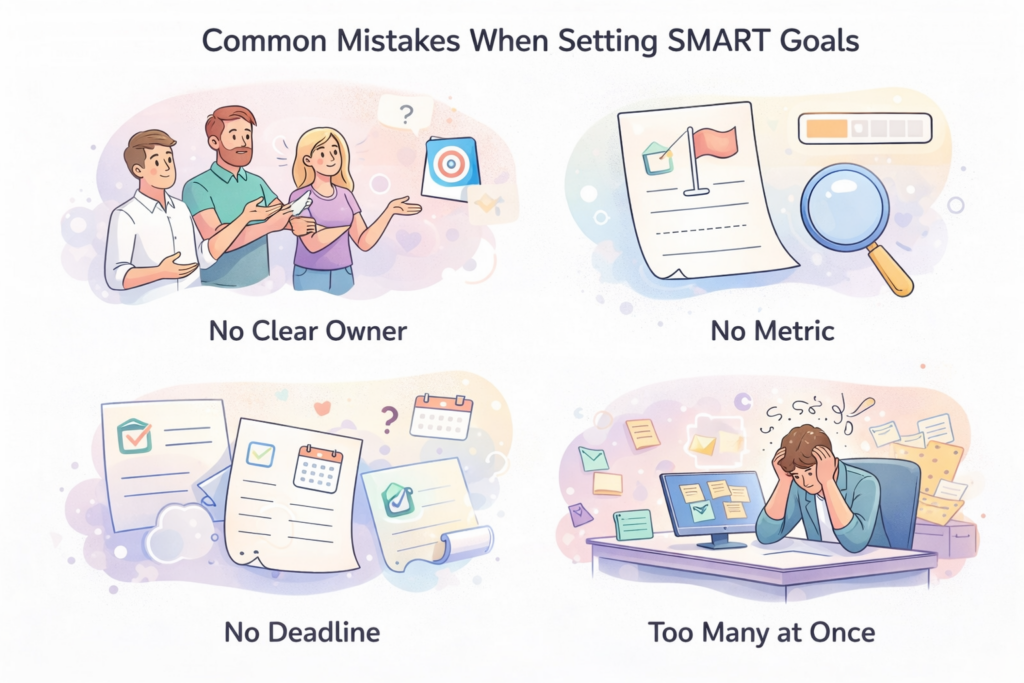
    Common Mistakes When Setting SMART Goals

    The framework helps, but it does not automatically prevent bad goal writing. Here are the patterns that undermine otherwise well-intentioned work.

    • Goals that are too broad to act on. If the goal could apply to ten different projects, it is not a goal yet. Pick one specific dimension and define it clearly.
    • No metric attached. A direction is not a target. If you cannot measure it, you cannot track it.
    • Stretch numbers with no baseline. Ambitious targets need an anchor. Without knowing where you currently stand, planning is guesswork.
    • Goals disconnected from current priorities. A well-written goal that serves no real team or business need is still a distraction.
    • No deadline. Open-ended goals drift indefinitely. Set a date, even if it gets adjusted later.
    • Written once, never reviewed. A goal without a tracking process is just a document. If no one is checking in on it, it will not get done.

    Why SMART Goals Still Fail Even When Written Well

    Here is the part most goal-setting articles skip over. Writing a well-formed SMART goal is not enough. A goal can pass every letter of the framework and still go nowhere.

    The most common reasons are operational, not structural.

    • No named owner. When a goal belongs to the team without a specific lead attached, accountability evaporates. Someone needs to be responsible for it.
    • No review rhythm. A 90-day goal checked on day 89 is not being tracked. Build in a 30 and 60-day check-in before the deadline arrives.
    • Not connected to tasks. Goals that live in a separate doc from the actual work get forgotten. The goal needs to exist inside the workflow, not parallel to it.
    • Too many goals at once. When everything is a priority, nothing is. Three focused goals will move faster than ten scattered ones.
    • No shared visibility. When goals are siloed, alignment breaks down. People optimize for their own piece without seeing how it connects to the whole.

    Writing the goal is step one. Building the system around it is what determines whether it actually gets done.

    SMART Goal Template

    Use this as a starting point. Adjust the language to match your team’s voice, but make sure all five criteria are present.

    “[Who] will [specific action or outcome] by [deadline], measured by [metric], because it supports [team or business objective].”

    Example: The content team will publish 8 SEO-focused articles by March 31, measured by monthly organic sessions, in order to reduce paid acquisition costs and grow top-of-funnel reach.

    For performance reviews and individual goals, the same structure works: “I will [action] by [date], tracked by [metric], in support of [team priority].”

    Vague Goals vs. SMART Goals

    Here is the difference in plain terms. The vague version tells you what you care about. The SMART version tells you what you will do, when, and how you will know it worked.

    Vague Get more customersSMART Acquire 40 new paying customers in Q2 through outbound and referral campaigns, tracked weekly in the CRM.
    Vague Improve the websiteSMART Increase homepage conversion rate from 1.8% to 2.4% by May 31 by redesigning the hero section and adding two customer case studies.
    Vague Make the team more efficientSMART Reduce time spent in recurring meetings by 20% by April 15 by auditing current meetings and cutting or shortening those with no defined output.
    Vague Onboard new hires betterSMART Reach a 30-day onboarding satisfaction score of 4.5/5 in Q3 by redesigning the onboarding checklist and pairing each new hire with a buddy for their first month.

    Keeping SMART Goals Alive in Real Work

    Once the goal is written, the operational side begins. This is where most goals either stick or quietly disappear.

    Goals work when they are embedded in the workflow, not stored separately from it. That means:

    • Break the goal into tasks with owners and due dates.
    • Set a mid-point review. Do not wait until the deadline to find out you are off track.
    • Document updates as the work happens. Context shared in real time is far more useful than a retrospective summary.
    • Keep goals visible across the team. When everyone can see what others are working toward, coordination improves and dependencies surface earlier.

    The goals that get completed are almost always the ones tied directly to the work, not the ones sitting in a separate planning doc. If goal-setting and task management live in different places, that gap is where follow-through breaks.

    Close the gap between goal and execution When goals live in one doc, updates live in Slack, and tasks live somewhere else entirely, follow-through breaks down. Skarya.ai keeps goals, tasks, owners, and progress in one visible workflow, so nothing gets lost between planning and delivery.

    Frequently Asked Questions

    What are SMART goals?

    SMART goals are goals that are Specific, Measurable, Achievable, Relevant, and Time-bound. The framework turns broad intentions into trackable work with a clear metric, owner, and deadline.

    What is an example of a SMART goal?

    “Increase win rate from 22% to 27% by end of Q3 by enforcing same-day lead follow-up and reviewing stalled deals every Friday.” It names the metric, the method, and the deadline.

    Why do SMART goals work better than regular goals?

    They remove ambiguity. When a goal is specific and measurable, everyone knows what success looks like. When it is time-bound, there is a date to plan backward from. Vague goals invite different interpretations, which is where misalignment starts.

    How do teams use SMART goals?

    Teams write goals at the team level, break them into tasks with individual owners, and review progress at set intervals rather than waiting for the deadline. It gives managers and employees a shared, unambiguous definition of success.

    What is the SMART goal template?

    [Who] will [specific action] by [deadline], measured by [metric], because it supports [objective]. All five criteria should be present.

    Can SMART goals be used for performance reviews?

    Yes. They work well in performance management because both manager and employee agree upfront on the criteria. When the review arrives, there is no debate about whether the goal was met.

    The Takeaway

    Vague goals are not a motivation problem. They are a design problem.

    The SMART framework gives you a repeatable structure for writing goals that can be planned, owned, and finished. Use it for performance reviews, team objectives, project milestones, or anything you want to actually get done.

    Write the goal. Name an owner. Break it into tasks. Check in before the deadline.

    Most goals fail because no one built a system around them. Now you have one.