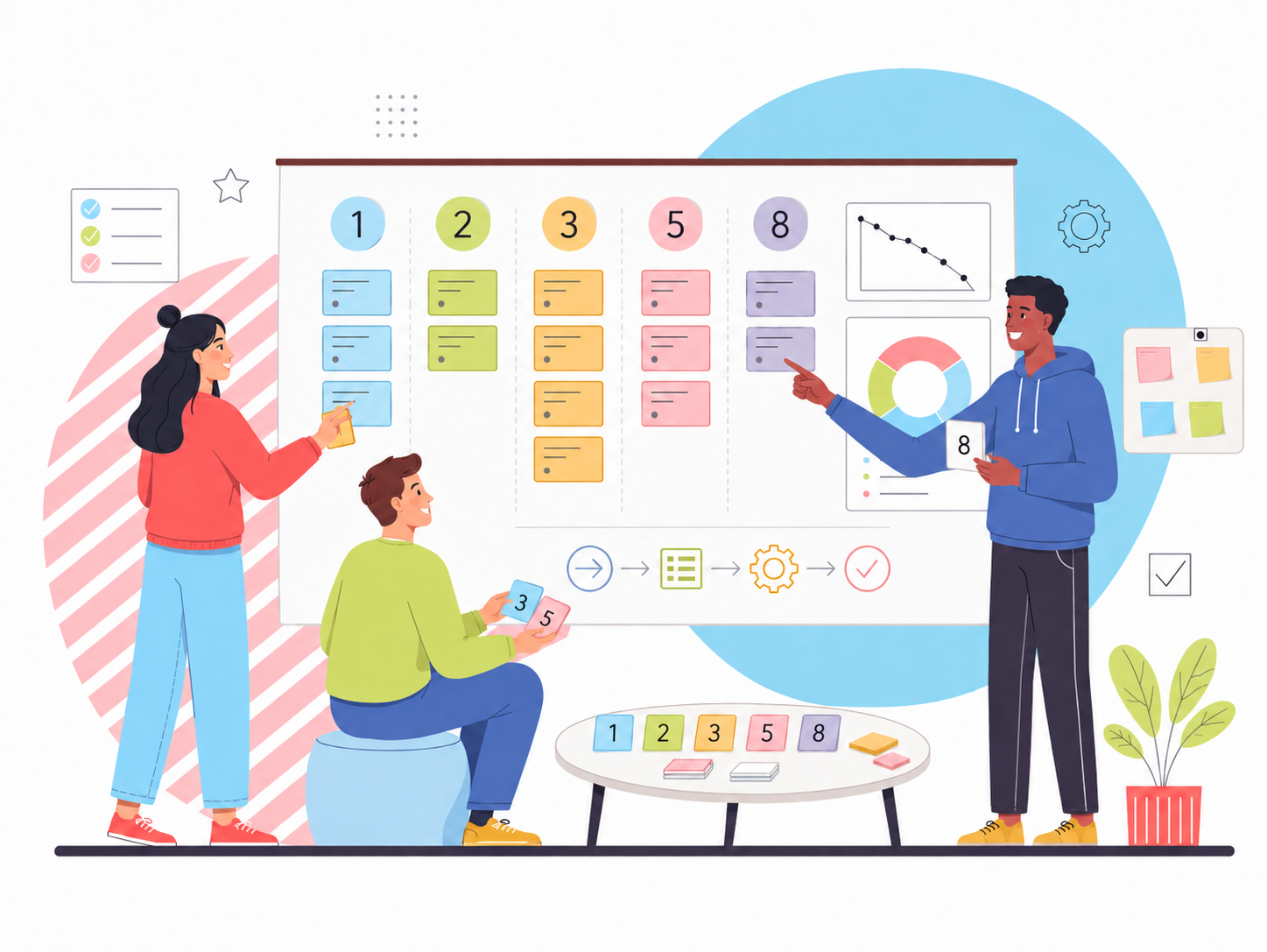
Two developers look at the same ticket. One says three points. The other says eight. Neither of them is wrong yet, they just haven’t talked about it. That five-point gap is the actual reason story points exist, and it’s the part most explanations skip straight past on their way to the Fibonacci sequence.
If you’ve sat through a planning poker session where the numbers landed nowhere near each other, you already know the real value isn’t the number the team lands on. It’s the few minutes of conversation between the first guess and the final one, where somebody finally says, “wait, why do you think this is that much bigger?”
Put simply, story points in Agile are a relative estimation method used to understand effort, complexity, and uncertainty before a team commits to work. They are common in Scrum story point estimation, but they are not a Scrum rule, a time unit, or a replacement for real discussion.
What Story Points Actually Measure
A story point is a number a team assigns to a task, a bug, or a user story, meant to capture three things at once: how much work is involved, how complicated that work is, and how much of it is still unknown. Those three don’t line up neatly, which is exactly why teams stopped guessing in hours and started guessing in points instead.
A task can be short and still carry real risk, like touching a payment flow nobody on the team has changed in two years. Another task can be long and completely predictable, like duplicating twelve near-identical landing pages from an existing template. Hours would treat these as similar. Points, done properly, wouldn’t.
The number itself isn’t a disguised unit of time. It’s closer to a shorthand for how nervous the team should be about a piece of work, filtered through effort and complexity together. A 2 usually means someone in the room has done almost exactly this before. An 8 usually means someone is quietly worried about what they don’t know yet, even if they can’t name it precisely.
Why Story Points Are Not Hours
This is where most estimation systems quietly fall apart. Somewhere in a team’s history, someone decides one point equals two hours, and from that point forward, the estimate stops being an estimate. It becomes a disguised deadline, and people start treating it exactly like any other hard commitment: padding numbers on unfamiliar work, avoiding anything with an unclear spec, or inflating points on anything involving a client who tends to change their mind mid-project.
Once points map cleanly to hours, the useful part of estimation disappears. Nobody needs to ask why one task feels bigger than another when the answer is just multiplication. And because two people can genuinely take different amounts of time on identical work (a senior developer who’s touched this exact integration a dozen times, a junior one seeing it for the first time), tying points to hours quietly turns an estimate of the work into a judgment of the person doing it.
It’s worth saying plainly: this isn’t a hypothetical failure mode. It’s the single most common way story points stop working, and it usually happens gradually enough that nobody notices until estimates start feeling like promises again.
Pro Tip: If someone asks “so how many hours is a point, roughly,” treat that as the moment to revisit the points-versus-hours conversation with the whole team, not as a question that deserves a clean answer.
Why Fibonacci Story Points Use 1, 2, 3, 5, 8, 13, 21
Ask a room to choose between 6 and 7 points and you’ll get a ten-minute argument that changes nothing about how the sprint plays out. Ask the same room to choose between 8 and 13, and the gap actually means something: someone is seeing hidden complexity the other person hasn’t spotted.
That’s the whole logic behind the Fibonacci-style scale. Small numbers sit close together because small tasks really can be sized accurately; the difference between a 1 and a 2 is usually obvious to everyone in the room. Past 8, the gaps widen on purpose, because nobody can honestly tell you whether a big, murky task is a 19 or a 22, and pretending otherwise just burns a meeting arguing over false precision.
A 13 or a 21 sitting in a backlog isn’t really a measurement. It’s a flag. It says this is too large and too uncertain to size honestly in its current form, so the conversation should be about splitting it, not about which number best captures it.
What each story point usually means
The exact meaning depends on each team’s own history, but a healthy Fibonacci story points scale usually has a clear pattern. A 1 is small and obvious. A 2 is still simple but needs a little more effort. A 3 is moderate and fairly understood. A 5 has more steps, more coordination, or more review involved. An 8 carries real complexity or uncertainty. A 13 is a sign the story may need to be split. A 21 usually means the work is too large or too unclear to commit to in its current form.
How Planning Poker Works in Story Point Estimation
Planning poker works because it hides everyone’s number until the whole room reveals together. Someone reads the ticket out loud, the team asks a handful of sharp questions about scope and edge cases, and then everyone silently picks a card.
The interesting moment isn’t when the numbers match. It’s when a 3 lands next to an 8. That gap usually means one person knows about a dependency, an approval step, or a messy edge case the other person hasn’t considered yet. The five seconds where three fingers go up next to eight fingers does more to surface hidden risk than an hour of status updates ever could.
Skip that reveal and estimate silently in a spreadsheet instead, and the exercise still produces numbers, just not the useful kind. The numbers come out fine. The conversation that was actually worth having never happens.
How Story Points Support Sprint Planning and Velocity
Velocity is simply the average number of points a team finishes per sprint, tracked over three or four cycles. If a team lands around 24 points a sprint on average, that number becomes a planning ceiling for the next sprint, not a target to beat.
Where this goes wrong is predictable. A manager starts treating velocity like a scoreboard, pushes the team to hit 30 points every sprint, and watches two things happen at once: estimates creep upward on work that hasn’t actually changed, and “done” starts meaning something looser than it used to. Neither of those is an improvement, even though the number on the chart looks better.
A dip in velocity isn’t automatically bad news either. Someone was out for half the sprint, a dependency landed three days late, or the work turned out to carry more edge cases than anyone flagged during refinement. Velocity is a planning input a team uses to size its own next sprint. It was never built to be a performance review, and teams that use it as one usually end up with worse data, not better output.
Pro Tip: Track velocity as a rolling four-sprint average rather than sprint by sprint. One bad sprint tells you almost nothing on its own. Four sprints in a row start to tell you something real about actual capacity.
Backlog Refinement: How Fuzzy Tasks Become Estimable
Nobody can put an honest number on “improve the dashboard.” Refinement is the session where that vague line turns into something a team can genuinely size: which chart, whose data, what approval step, what “improve” actually means to the person who wrote the ticket in the first place.
Skip refinement and the cost shows up immediately in planning. The room stalls on basic questions nobody thought to ask ahead of time. Estimates come back wildly inconsistent because half the team is picturing a different task to the other half. The sprint starts carrying more uncertainty than it needed to, and that uncertainty doesn’t disappear, it just gets discovered later, mid-sprint, at a worse time.
Refinement also catches work that shouldn’t be estimated yet at all. Some tickets need a stakeholder decision before anyone can size them honestly, and forcing a number onto that kind of task just produces a confident-looking guess built on a question nobody’s actually answered.
Fifteen minutes of refinement the week before a planning session routinely saves an hour of confused back-and-forth in the meeting itself. That trade is almost never a bad one.
When a User Story Should Be Split
A 13 or a 21 sitting in a sprint is rarely one task. It’s usually three or four smaller ones wearing a trench coat. “Build the reporting dashboard” quietly contains wireframes, a chart component, a data connection, filter logic, and a stakeholder review, each one genuinely estimable on its own once it’s pulled apart.
Splitting isn’t just tidier bookkeeping, either. It changes what the team can actually show partway through a sprint. A single 13-point task is either done or not done by demo day, with nothing useful to show in between. Five smaller pieces let the team demonstrate progress as it happens, and let a stakeholder catch a wrong assumption on day three instead of finding out on day twelve that the whole thing was built on a misunderstanding.
What a Healthy Sprint Point Spread Looks Like
Most sprints hold up better with a mix, not a pile of similar-sized tickets. A sprint made entirely of 8s and 13s usually means the backlog wasn’t refined properly before planning, and the team is about to discover a lot of hidden complexity mid-sprint. A sprint made entirely of 1s and 2s can look productive on a burndown chart, but it’s often busywork dressed up as delivery, with the genuinely hard problem quietly pushed to next sprint again.
A sprint that mixes a couple of small, low-risk tasks with two or three medium ones, and maybe one larger, well-understood piece, tends to hold up better under pressure. If something runs long or a dependency falls through, there’s still enough smaller work to finish and demo, rather than the whole sprint riding on one large ticket landing perfectly.
Story points beyond software
Story points started in software teams, but the same logic holds anywhere work gets planned in short cycles. A one-line copy fix on a website is a 1. A blog outline with a clear brief is a 3. A full SEO article with research, drafting, and editing sits closer to 5 or 8, depending on how much of the research still needs doing. A campaign landing page with strategy, design, build, tracking, and sign-off easily runs 8 to 13, not because the words take longer to type, but because that many people and approvals genuinely have to line up before it ships.
The size differences matter for the same reason they matter in software: a 1 and an 8 shouldn’t be scheduled the same way inside a week. A content team that treats every blog post as roughly equal effort ends up either overcommitting a sprint or leaving capacity sitting idle, the same mistake a dev team makes when it quietly assumes every ticket takes about a day.
One practical way to apply this is to keep story points visible beside real delivery signals after a sprint closes. In Skarya, for example, teams can plan with Sprint and Story Points fields in the Agile Development Board, then compare Allocated Effort with Actual Effort across Phase and Iteration. The point is not to convert story points into hours. It is to notice where estimates held up, where they did not, and what the team should learn before the next planning session.
Who Should Estimate Story Points?
The people doing the work should be the ones sizing it. A manager assigning points from outside the work is really just assigning a deadline with extra steps. A product owner estimating alone misses whatever the developer, designer, or tester in the room would have flagged in the first thirty seconds of looking at the ticket.
Cross-functional work needs cross-functional estimation. A designer spots the two rounds of stakeholder feedback that always show up on this kind of request. A developer spots the API that’s changed twice already this year. A tester spots the edge case nobody bothered to mention in the ticket description. Leave any of those voices out of the room, and the number that comes out the other end is a guess wearing an estimate’s clothing.
Common Story Point Estimation Mistakes
The most common failure isn’t a bad number, it’s a good number used badly. Points get compared across two different teams as though a 5 means the same thing to both of them, when every team’s scale is really calibrated to its own history and its own skill mix. Points get used to rank individual output, turning a planning tool into a performance metric it was never designed to be. Points get quietly inflated on anything involving a difficult client or an unclear spec, until nearly everything lands on 8 regardless of what it actually involves.
None of this means story points are the problem. It means the discipline around them slipped, usually without anyone deciding it should.
Pro Tip: If nearly every ticket in a sprint lands on the same one or two numbers, that’s not consistency. It’s a sign the scale has stopped meaning anything, and it’s worth resetting against three or four shared reference tasks the whole team agrees on.
Are Story Points Just Guessing With Extra Steps?
Fair question, and one worth answering honestly rather than waving away. Yes, a story point is still a guess. Nobody serious claims otherwise. What changes is who’s doing the guessing and how visible the disagreement becomes. One person guessing alone in a spreadsheet produces a single set of blind spots, multiplied quietly across the whole backlog. A room of five people guessing out loud, comparing numbers, and arguing over the gaps produces something closer to a shared, tested guess, one that’s already survived a round of scrutiny before the sprint even starts.
That doesn’t make the estimate accurate in any absolute sense. It makes it calibrated, which is a different and more useful thing. An estimate a team has argued about is worth more than a precise-looking number nobody has questioned.
Do All Agile Teams Need Story Points?
Story points aren’t mandatory, and plenty of well-run teams operate without them. Some size work in t-shirt sizes, small, medium, large, when a rougher signal is genuinely enough. Some track cycle time and throughput instead, particularly teams running continuous flow rather than fixed sprints. Some just estimate in hours honestly, without pretending the number is more precise than a guess with digits attached.
The right call depends on what the team is actually trying to learn. If the goal is understanding relative effort and planning sprint capacity with some rigour, points earn their keep. If the team just needs a rough read on size without the planning-poker overhead, t-shirt sizes get there faster and with less process. There’s no prize for running the more complicated method if the simpler one already tells the team what it needs to know.
Final Thoughts
A story point stays useful for exactly as long as it stays a conversation starter instead of a scoreboard. The moment it turns into a hidden deadline, or a way to quietly compare people against each other, it’s already stopped doing its job. It’s worth pulling the team back, every so often, to what the number was actually meant to protect in the first place: an honest, shared read on how big something really is before anyone commits to delivering it.
Frequently Asked Questions
What are story points in Agile?
Story points are numbers a team assigns to a task, bug, or user story to capture its effort, complexity, and uncertainty relative to other work. They help the team compare work size before the sprint starts, instead of pretending every task can be predicted in exact hours.
What is story point estimation?
Story point estimation is the team process of discussing a task and agreeing on its relative size. The estimate is useful only when it comes from shared context, not from one person assigning a number in isolation.
Are story points part of Scrum?
Story points are commonly used by Scrum teams, but they are not mandatory in Scrum. They are an Agile estimation technique many Scrum teams choose because they make sprint planning and backlog refinement easier to discuss.
Are story points the same as hours?
No. Story points measure relative size and risk, not duration. Converting them into hours turns the estimate into a hidden deadline, and it removes the reason teams use points in the first place: to discuss effort, complexity, and uncertainty honestly.
Why do teams use the Fibonacci scale for story points?
The widening gaps between 1, 2, 3, 5, 8, 13, and 21 stop teams arguing over false precision on large, uncertain work. The scale keeps small tasks easy to size, while making it obvious when bigger work carries more risk and should possibly be split.
What is planning poker?
Planning poker is an estimation method where each team member privately picks a story point value, then everyone reveals at once. Big gaps between individual estimates usually point to hidden risk, missing context, unclear scope, or assumptions the team needs to discuss before committing.
What is velocity in Agile?
Velocity is the average number of story points a team completes per sprint, typically tracked over three or four sprints. It helps with sprint capacity planning, but it should be treated as a planning signal, not a target to push higher every single cycle.
When should a story be split instead of estimated?
When a task lands around 13 or 21 points, it is usually several smaller, genuinely estimable pieces bundled together. Splitting it improves estimate accuracy, reduces sprint risk, and gives the team better visibility into progress partway through the sprint.
Can non-software teams use story points?
Yes. Content, marketing, design, and service delivery teams can use story points the same way. A quick copy edit might be a 1, while a full campaign landing page with strategy, design, build, tracking, and sign-off can run 8 to 13.
Do all Agile teams need to use story points?
No. Some teams use t-shirt sizes, hours, or flow metrics like cycle time instead. Story points help most when a team wants to plan sprint capacity around relative effort, compare work across a backlog, and make estimation conversations more visible.