Early-stage startups don’t fail because founders can’t plan.
They fail because they fall into the Process Trap.
It starts innocently. A tool meant to “add structure” becomes a system that demands structure before you have the time, headcount, or patience to maintain it.
Here’s what that actually costs.
If a five-person team loses just two hours a week to tool management, that’s ten hours gone. More than a full workday. Every single week.
That’s a shipping tax. Lean project management is how you stop paying it.
Founder tip: If your PM tool needs a “how to use this” Loom for new hires, it’s already too complex.
Why Enterprise Tools Don’t Work for Startups
Founders often reach for enterprise tools because they feel safe. “Enterprise-grade” sounds like “future-proof.”
In practice, it usually means interruptions.
Every mandatory field in a heavyweight system is a cognitive break. It pulls someone out of the work to satisfy the tool. It looks like this.
- Assigning a task requires filling in status, priority, labels, sprint, story points, and a custom field nobody remembers creating
- Updating progress becomes a ritual instead of a natural by-product of doing the work
- The tool becomes a second job that someone has to manage
Most enterprise setups also quietly assume something startups don’t have. A dedicated admin.
Jira is excellent in large environments. But it often comes with a hidden cost. A Jira Admin. Startups don’t have admins. They have founders who should be talking to customers, shipping product, and making the next two hires.
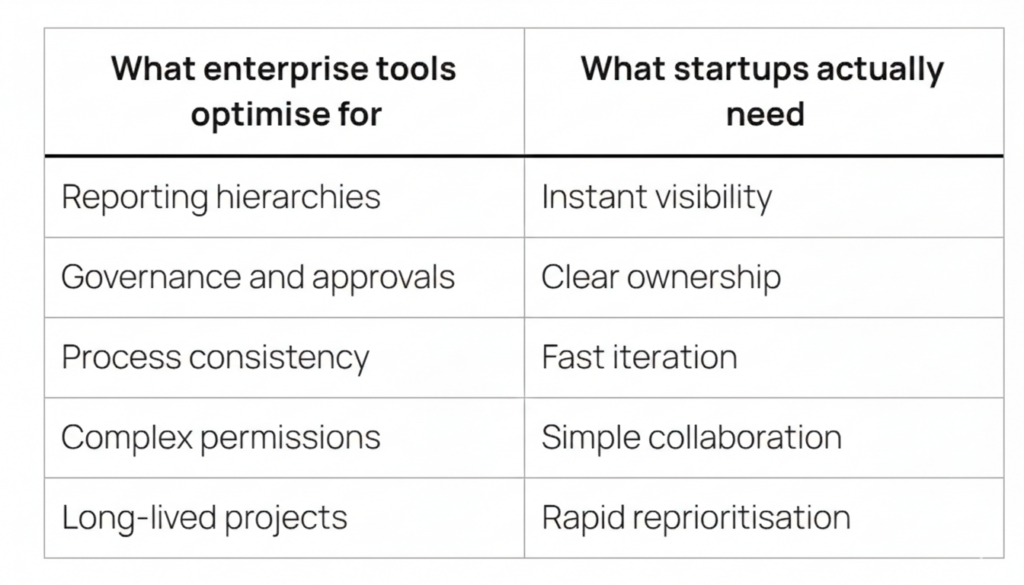
The mismatch isn’t about quality. It’s about timing.
What Lean Project Management Actually Looks Like
Lean project management isn’t fewer features. It’s fewer obstacles.
In a startup, alignment happens fast. In Slack. Over coffee. In a quick call. Your tool shouldn’t create alignment. It should capture it with near-zero friction.
Tasks in early teams are often ephemeral. Today’s plan is tomorrow’s context. A good lightweight PM tool handles pivots naturally, without broken dependencies, stale backlogs, or weeks of cleanup.
The goal isn’t perfect planning. It’s fast alignment that stays visible.
What to Actually Look For in a Lightweight PM Tool
Here’s the simplest filter that works.
The 60-Second Rule
If a new hire can’t join your workspace and move a task card within 60 seconds, the tool is too heavy. Everything else is secondary.
Beyond that, a simple PM tool for startups should deliver the basics exceptionally well.
Minimal setup, immediate clarity
Create a project, add tasks, assign ownership, done. No templates required. No configuration checklist.
Execution-first design
In startups, the “how” is often decided inside the task itself. Comments become documentation. The tool should keep discussion and execution together so context doesn’t leak across apps.
One place for work
If tasks live in one place, docs in another, and updates somewhere else, momentum dies in the gaps. Connected work reduces mental load and missed handoffs.
Visibility without micromanagement
You should see what’s moving and what’s stuck without chasing anyone for updates.
Founder tip: The best system is the one you can ignore most of the day and still understand in 10 seconds.
The Jira Trade-Off Power vs Timing
Jira is the right tool for large teams. Think 500 plus people, strict compliance needs, and long-running programmes. In that environment, it earns its complexity.
For early-stage teams, the risk is premature scaling.
Adopting a heavyweight PM system too early is like hiring a CFO before you have revenue. It might be the right call eventually. Right now, it creates process debt.
Early teams don’t need dependency graphs, permission matrices, or multi-layer reporting. They need speed, clarity, and flexibility, and they need it today.
How Skarya Fits the Startup Reality
Skarya is built for teams that want structure without rigidity. Not more process. Just a cleaner flow.
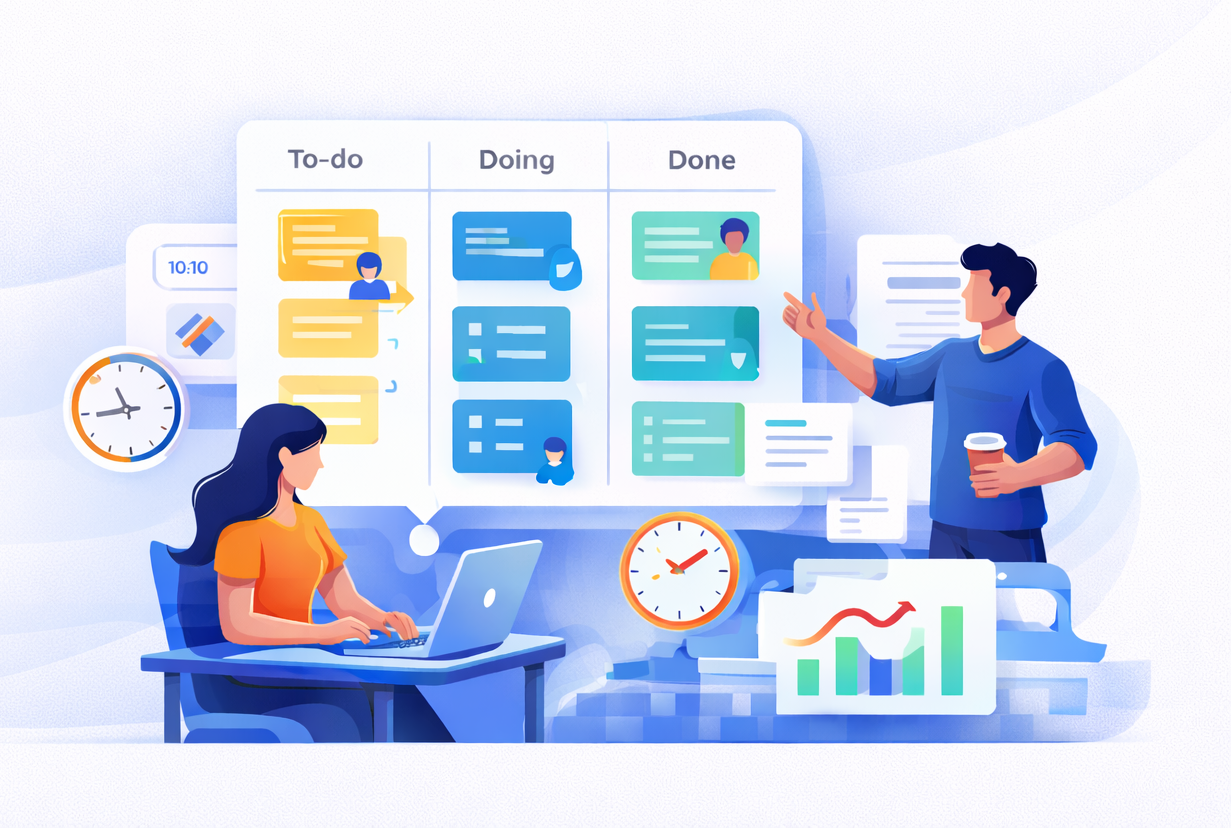
Kanban boards that make work visible instantly
What’s in progress, what’s next, what’s blocked, at a glance. No setup marathon. No training session required.
Built-in timesheets that sit alongside your tasks
This is the part most startup tools ignore. Tracking time shouldn’t mean switching tools, rebuilding context, or dreading Friday afternoon catch-ups.
It matters more than founders expect, especially when you’re billing clients, preparing for audits, or making an R&D tax claim. Skarya gives you a clean, automatic record of where time actually went, without adding another process to maintain.
No admin overhead. No bloat. Just the clarity a small team needs to stay focused and move fast.
Start Simple. Scale When You’re Ready.
The best project management system for a startup is the one that gets out of the way.
Enterprise-level complexity can wait. Execution can’t.
Set up your first Skarya board in 30 seconds and get your team’s focus back where it belongs.
Leave a Reply