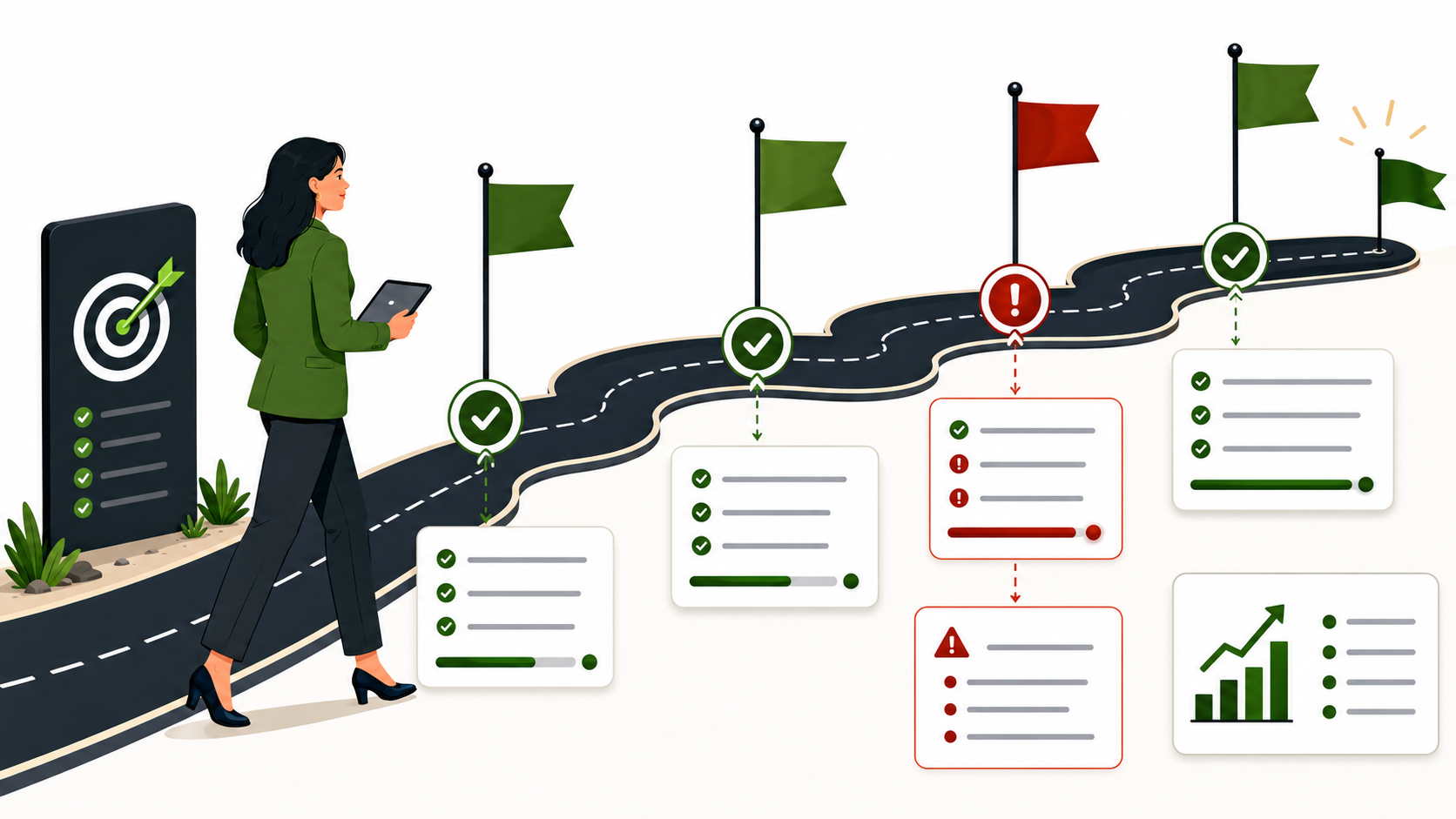
A quarterly execution plan should do more than capture goals. It should connect those goals to the real delivery system underneath them: projects, tasks, owners, timelines, resources, timesheets, client work, and financial visibility.
Many teams are good at setting quarterly goals. The harder part is making sure those goals actually change how work happens every week. A goal that lives in a deck may look clear during planning, but delivery usually lives somewhere else. It lives in boards, schedules, task lists, resource calendars, client updates, and team check-ins.
That gap is where execution slows down.
Key takeaways
- A strong quarterly execution plan turns goals into visible delivery signals before the quarter begins.
- Weekly pulse checks help teams catch drift early without turning every update into a long review meeting.
- For service businesses, delivery progress and financial visibility should be reviewed together, not separately.
The gap between setting goals and shipping work
Most planning does not fail because the goal is wrong. It fails because the goal is not connected to the way work actually gets delivered.
A leadership team may define a goal like improving delivery margin, reducing project delays, increasing client satisfaction, or launching a new service line. On paper, the goal is clear. But once the quarter starts, the delivery team returns to active projects, urgent tasks, client requests, internal blockers, and changing priorities.
Neither side is wrong. The goal matters. The delivery work matters. The issue is that both often operate in separate spaces.
The goal lives in a planning document. Delivery lives in the board. Time is tracked somewhere else. Financial visibility comes later. Client updates move through email or meetings. By the time everyone understands what is really happening, the quarter may already be halfway done.
This is why a quarterly execution plan should not only answer, “What do we want to achieve?” It should also answer, “Where will this goal show up in the work?”
Why this keeps happening and why good intentions don’t fix it
Teams usually begin the quarter with good intent. They want better focus, clearer priorities, stronger ownership, and fewer last-minute surprises. The planning meeting feels useful because everyone agrees on what matters.
Then the real quarter begins.
A client asks for something new. A milestone takes longer than expected. A team member gets pulled into urgent work. A small scope change creates extra effort. A project that looked simple becomes more complex. The delivery system starts changing every week, but the plan often remains fixed in its original version.
This happens because planning and delivery run on different rhythms. Planning is often quarterly. Delivery is daily. Reporting may happen monthly. Financial review may happen even later. When these rhythms are not connected, teams can drift without noticing it early enough. A useful strategy execution framework helps solve this by connecting goals to the practical operating system of the business. It makes the goal visible inside the work, not just above the work.
Tip: Before the quarter begins, ask one simple question: “Where will this goal live after the planning meeting?” If the answer is only “in a document,” the goal is already at risk.
Step 1 Translate goals into delivery signals before the quarter starts
A goal is not ready for execution just because it sounds clear.
For example, “improve project profitability” is a useful business goal. But what does it look like in delivery? Does it mean reducing non-billable hours? Does it mean improving estimates? Does it mean reviewing scope changes faster? Does it mean assigning senior resources more carefully? Does it mean improving timesheet accuracy?
Until the goal becomes visible in the delivery system, the team cannot act on it consistently.
This is where teams need to translate each quarterly goal into delivery signals. A delivery signal is a practical marker that shows whether the goal is moving, stuck, or drifting. It could be a task status, a board column, a project milestone, a timesheet category, a utilization view, a budget threshold, or a weekly review point.
If the goal is to improve delivery predictability, the signals might include overdue tasks, missed milestones, blocked work, approval delays, and estimated versus actual effort. If the goal is to improve margin, the signals might include billable hours, non-billable time, resource allocation, scope changes, and margin by project.
This is also where a clear project schedule matters. A schedule should not only show dates. It should show the connection between the goal, the work, the owner, and the delivery timeline.
Step 2 Run a weekly pulse, not a full review
A weekly pulse is not a long status meeting. It is a short check to see whether the quarter is still moving in the right direction.
The difference is important. A full review asks, “What happened?” A weekly pulse asks, “What is changing early enough for us to act?”
This keeps the meeting light and useful. The purpose is not to review every task or discuss every detail. The purpose is to check the few signals that matter most.
A weekly pulse can be done in 15 minutes. Review what moved, what is blocked, what changed, who needs support, and whether any of those changes affect the quarterly goal. This gives the team enough visibility to adjust early without slowing down delivery.
Many teams create problems by doing one of two things. They either over-review work and turn every week into a heavy meeting, or they under-review work and wait until the end of the quarter to discover that the plan drifted weeks ago.
A weekly pulse sits between both extremes.
Tip: Keep the weekly pulse focused on movement, blockers, ownership, and risk. If the conversation turns into a full post-mortem, save it for the quarterly look-back.
Step 3 Keep financial and delivery data visible in the same view
For service businesses, delivery is never only a task story. It is also a margin story.
A project may look healthy on the board but still quietly lose money. Tasks may be moving. The team may look busy. Client updates may sound positive. But if non-billable time is increasing, scope is expanding, or the wrong resources are overloaded, the financial reality may not show up until much later.
That delay creates risk.
Delivery teams need to see the relationship between work and value while the quarter is still active. Not after the quarter ends. Not only when finance reviews the numbers. Not when someone manually pulls together a report six weeks later.
This is why resource planning, timesheets, project progress, and financial visibility should sit inside the same operating rhythm. A project manager reviewing delivery progress should understand where time is going. A delivery leader reviewing workload should see which projects are creating pressure. A founder or finance-aware operator should know whether the work being shipped is supporting the business goal.
This connects directly to managing resources. Resource planning is not just about availability. It is about whether the right people are working on the right work at the right time, with the right business context.
Step 4 Run the quarterly look-back with four honest questions
At the end of the quarter, many teams jump straight into scoring. Did we hit the goal? Are we behind? What percentage did we complete?
Those questions matter, but they are not enough.
A quarterly look-back should help the team understand what happened, why it happened, and what should change next. The aim is not to blame the team. The aim is to improve how the next quarter is planned and delivered.
Start with four honest questions:
- What moved forward because of this goal?
- What did we learn from the work?
- What changed in the business, team, client, or delivery environment?
- Should this goal remain, refresh, or retire?
The last question is the most important. Not every unfinished goal should be abandoned. Not every active goal should continue. Not every missed goal is a failure. Sometimes the right move is to stay the course. Sometimes the goal still matters, but the scope or metric needs to change. Sometimes the goal no longer deserves delivery capacity.
| Decision | When to use it | What to do next |
|---|---|---|
| Remain | The goal is still relevant and the delivery signals are healthy. | Keep the goal active, confirm owners, and carry the right work forward. |
| Refresh | The goal still matters, but the scope, timing, owner, or metric needs to change. | Update the goal, adjust the delivery plan, and reassign resources where needed. |
| Retire | The goal no longer fits the current business priority or delivery reality. | Close it clearly, capture the learning, and remove related work from active planning. |
This decision process is inspired by the practical idea of regularly reviewing and refreshing goals, similar to the approach shared in Atlassian’s article on goal refresh cycles. The important shift for service businesses is to review goals through the lens of delivery, capacity, client work, and margin.
Step 5 Change how work is structured, not just what the goals say
This is where many quarterly reviews fail.
The team discusses the quarter, updates the goal, agrees on the new direction, and leaves the meeting feeling aligned. But the delivery system underneath stays the same.
The board does not change. The task owners do not change. The project schedule does not change. The resource allocation does not change. The dashboard does not change. The timesheet categories do not change.
So the team has a new goal running on an old operating system.
A quarterly execution plan should always end with structural updates. If a priority has changed, the board should show it. If a project is no longer important, it should not keep consuming attention. If a metric has changed, the dashboard should reflect it. If a resource is overloaded, allocation should be adjusted. If a client deliverable is now critical, it should have visible ownership.
This is the difference between refreshing the language of a goal and refreshing the work itself.
For broader execution discipline, external guidance from the Project Management Institute can also help teams understand why structured planning, ownership, and delivery governance matter in project-led work.
Goals should pull delivery forward, not chase it
A quarterly execution plan should not become another planning document that teams forget after the meeting.
It should become the bridge between business direction and daily delivery.
The goal gives the team a reason to move. The delivery system shows whether that movement is real. The weekly pulse catches drift early. The quarterly look-back helps the team decide what should remain, refresh, or retire. Financial and resource visibility help the business understand whether delivery is supporting the bigger outcome.
The best teams do not treat goals as something separate from the work. They make goals part of how work is planned, assigned, tracked, reviewed, and adjusted.
That is the real purpose of quarterly execution planning.
Not more meetings. Not more documents. Not more reporting for the sake of reporting.
Just a clearer connection between what the business wants and what the team delivers every week.
FAQ
What is a quarterly execution plan?
A quarterly execution plan is a 90-day operating plan that connects business goals to projects, tasks, owners, schedules, resources, and review rhythms. It helps teams turn strategy into visible delivery work.
How is a quarterly execution plan different from quarterly goal setting?
Quarterly goal setting defines what the team wants to achieve. A quarterly execution plan defines how that goal will move through delivery, including ownership, project structure, schedules, resource allocation, and progress signals.
Why do quarterly plans fail?
Quarterly plans often fail when goals remain disconnected from daily work. If goals live in a document while delivery happens across boards, chats, timesheets, and reports, teams lose visibility and drift from the original priority.
What should teams review every week during a quarterly plan?
Teams should review priority movement, blockers, ownership gaps, delivery risks, resource pressure, and any change that affects the quarterly goal. The weekly pulse should be short and focused, not a full retrospective.
How can service businesses improve quarterly execution?
Service businesses can improve quarterly execution by connecting project delivery, time tracking, resource planning, and financial visibility in the same review rhythm. This helps teams see whether work is progressing and whether that work is supporting margin and capacity goals.