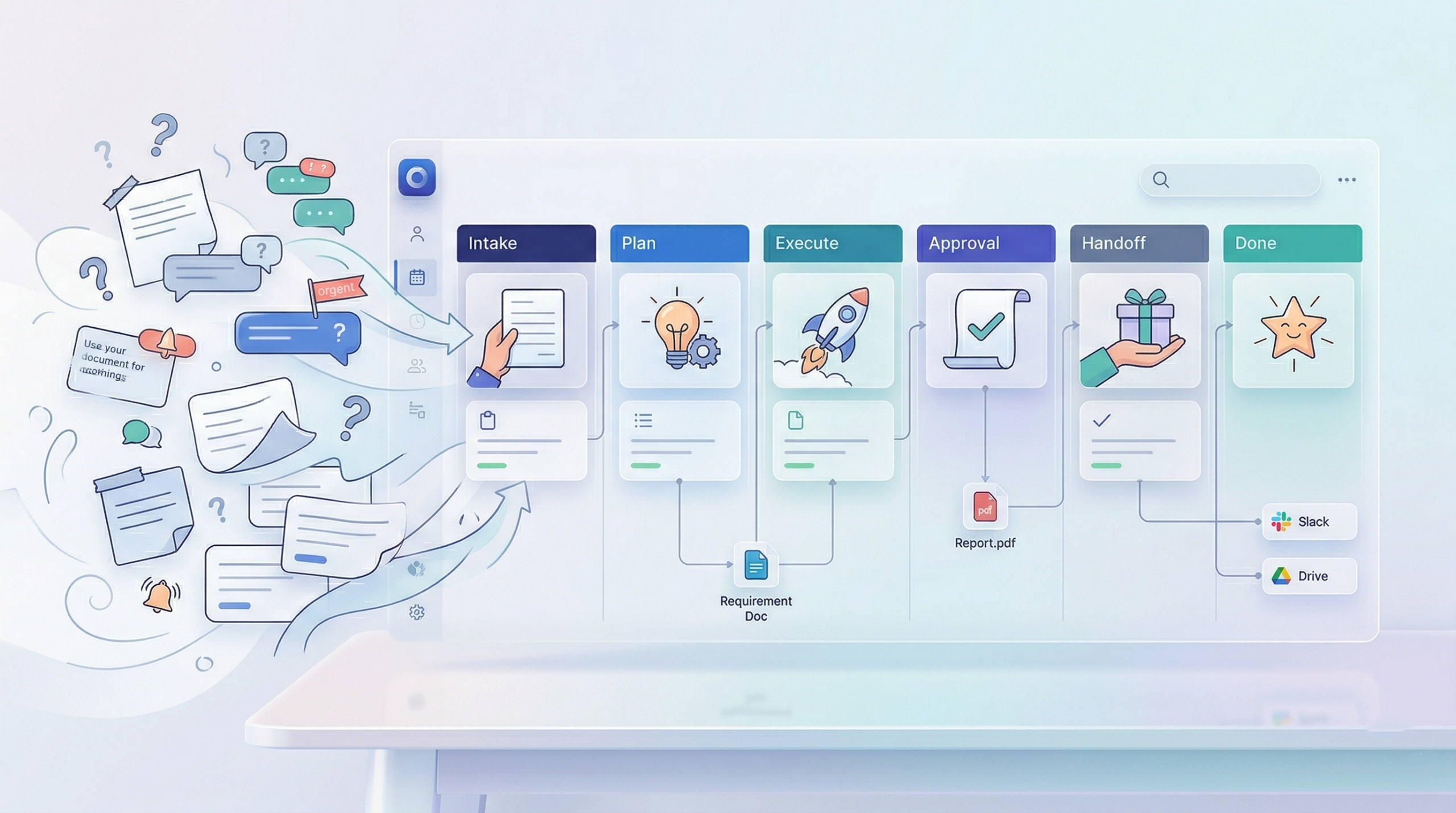
Standardising workflows means defining consistent, repeatable steps for how your operations team handles recurring work from intake to approval to completion so the outcome is predictable regardless of who does it or when.
| Key Takeaways Workflow standardisation reduces the three biggest hidden costs in ops: unclear ownership, missed handoffs, and repeated decision-making on tasks that should already have a process. Effective standardisation starts with auditing, where work comes from not with building documentation in a vacuum. The goal is fewer judgment calls, not more process. Your team should be able to execute without stopping to ask what the right approach is. Approvals fail because they live in inboxes and chat, not because approvers are unresponsive. Moving approvals into the workflow itself fixes most bottlenecks. Teams that centralise visibility spend significantly less time on manual follow-up and status chasing. |
How to Standardise Workflows for Operations Teams (Without Creating More Red Tape)
TL;DR: This is a practical guide for operations managers, ops leads, and growing service teams dealing with messy handoffs, stalled approvals, and repeat work done differently every time. It walks through a five-step approach to building consistency across your ops workflows without adding the kind of bureaucracy your team will ignore by week three.
Why do operations teams keep reinventing the same wheel?
If your team is handling recurring work client onboarding, internal requests, approvals, resource allocation and each task still gets managed slightly differently depending on who picks it up, you have a workflow standardisation problem. Not a talent problem. Not a communication problem. A structure problem.
This guide is for operations managers, ops leads, and founders handling ops in growing service businesses. The ones dealing with work that arrives through too many channels, approvals that disappear into email threads, and repeat tasks handled five different ways by five different people.
Standardising workflows is the fix. Done right, it doesn’t mean bureaucracy. It means your team stops burning time on decisions that should already be made.
What does it actually mean to standardise a workflow?
Workflow standardisation means defining, documenting, and consistently applying the steps your team takes to complete a repeatable task so the outcome is predictable regardless of who does it or when.
The distinction worth drawing early: standardising a process is different from standardising a tool. Plenty of ops teams buy a platform and call that standardisation. But if people still use different channels, different interpretations of done, and different methods for the same task, the tool just adds another layer of noise. Process comes first. Tooling supports it.
💡 Pro Tip: Before you document a single step, agree on what ‘complete’ looks like for your most common task types. If your definition of done is fuzzy, your process will be too.
Why do operations workflows break down in growing teams?
There are four root causes that show up consistently, and they compound each other.
Work comes from too many channels. Slack, email, in-person, project comments every channel is a separate queue someone has to manually triage. Most tasks don’t fail because they weren’t done. They fail because they were never properly received.
Ownership isn’t defined until something breaks. Tasks get loosely assigned or assumed. When the handoff happens at 4:47pm over chat, the receiving person either misses it or doesn’t know what’s expected. The gap between one person’s ‘done’ and another person’s ‘started’ is where most ops failures live.
Repeat tasks are handled by memory, not method. Every experienced team member has their own version of how a recurring task gets done which works fine until they’re out sick, move on, or simply weren’t around when the task came in. Knowledge stuck in someone’s head is a liability.
Approvals live in the wrong place. When approvals happen via email thread or Slack message, they get buried. Decisions stall not because the approver doesn’t care but because the request never surfaced clearly enough to prompt one. The problem isn’t the person. It’s the system.
“The bottleneck is never where you think it is. In operations, it’s almost always in the handoff the space between one person’s done and another person’s started.” Eliyahu Goldratt, The Goal
Here’s what each breakdown looks like and what standardising actually changes:
| Common breakdown | What standardisation fixes |
| Work arrives via Slack, email, verbal requests, and chat | A single intake channel or form every request is logged |
| Nobody’s sure who owns the task until something breaks | Named owners defined before work starts |
| Approvals stall in inboxes for days at a time | Approval steps built into the workflow, not bolted on |
| Same task is handled five different ways by five people | Documented steps anyone can follow without asking |
| Progress is invisible chasing updates is a daily habit | Live task boards where status reflects reality in real time |
| Handoff context gets lost between people and systems | Structured handoff notes and task templates with required fields |
What does a standardised workflow actually look like in practice?
Take client onboarding one of the most common sources of chaos in service businesses. Without a standard process, onboarding happens differently every time: sometimes kicked off by an email, sometimes a Slack message, sometimes verbally at the end of a call. The result is missed steps, delayed starts, and new clients whose first experience is confusion.
Here’s what the same workflow looks like when it’s standardised:
| Stage | What happens | Who owns it | What a standard process looks like |
| Intake | Client onboarding request received | Operations lead | Request submitted via intake form not email. Logged automatically as a task. |
| Assignment | Task routed to the right person | Ops lead or system rule | Owner named in the task. Due date set. Brief included in the task description. |
| Approval | Scope or cost confirmation needed | Account manager | Approval step built into the board task can’t move forward until marked approved. |
| Execution | Work completed by assigned team member | Delivery team | Progress tracked on the board. Status updated in real time no manual check-in needed. |
| Handoff | Completed work handed to client or next team | Delivery lead | Completion marked. Handoff notes attached. Client notified via standard template. |
Every stage has a clear trigger, a named owner, and a defined outcome. Nobody has to remember what comes next. Nobody has to chase for an update. The same logic applies to purchase approvals, resource requests, or any other recurring operation in your business.
How do you standardise workflows step by step?
The temptation when starting this work is to jump straight to documentation. Resist it. You can’t write a useful process without first understanding what’s actually happening. Here’s the sequence that works.
Step 1: Audit where work actually comes from
What to do: Spend one week logging every incoming request channel, task type, who handled it, and how long it took.
Why it matters: Most ops teams are managing 6 to 8 intake channels when they should be managing 1 or 2. You can’t standardise a workflow if the entry point varies every time.
What breaks if you skip it: You’ll document a process that only covers 60% of how work actually arrives and the other 40% will continue to fall through the cracks.
Step 2: Define ownership before you define process
What to do: For each category of recurring work, name a single owner. Not a team a person. Ownership means accountability for it being done correctly, not necessarily doing it themselves.
Why it matters: Process without clear ownership is documentation nobody reads. This is also where you build clearer communication across teams into the structure so context travels with the task, not separately from it.
What breaks if you skip it: Tasks move forward without a decision-maker attached to them. When something goes wrong, the postmortem becomes a conversation about blame rather than process.
Step 3: Document the repeatable tasks not the one-offs
What to do: Focus documentation on tasks that happen at least twice a month and involve more than one person. For each one: trigger, steps, owner, definition of done.
Why it matters: These are your highest-leverage targets. One page of documentation on a task done 20 times a month has far more impact than a detailed playbook for something that happens once a quarter.
What breaks if you skip it: Institutional knowledge stays stuck in whoever handled it last. When that person is unavailable, the task either stalls or gets done wrong.
💡 Pro Tip: Keep every process document to one page where possible. If it’s longer, you’re probably documenting exceptions rather than the standard path. Write for the 80% case; handle exceptions as they arise.
Step 4: Build approval paths into the workflow, not around it
What to do: Move approval steps into your work management system so they’re visible, assigned to a specific person, and create a record when completed.
Why it matters: Approvals that live in inboxes are approvals waiting to be forgotten. In practice, this works best when approvals, task states, and notifications all live in the same system so decisions surface automatically rather than requiring manual follow-up.
What breaks if you skip it: Work stalls at approval stages not because the approver is unresponsive, but because the request got buried. You end up with the same ‘I thought you approved it’ conversation on a loop.
Skarya handles this by building approval workflows directly into boards tasks can’t progress past certain stages until marked approved, and the right person is notified automatically. You can also automate the repetitive parts of your workflow timesheet submissions, status updates, and notifications to cut the manual follow-up your team does by hand.
Step 5: Centralise visibility so nothing lives in someone’s head
What to do: Move the state of work into a live system where task status, ownership, and progress reflect reality in real time.
Why it matters: When the whole team can see what’s in progress, what’s stuck, and what’s waiting on a decision, the number of ‘just checking in’ messages drops sharply. So does the cognitive load on whoever used to hold all that information in their head.
What breaks if you skip it: You centralise the process without centralising the visibility. Work gets done, but nobody can see it happening so you’re still chasing updates, just with a cleaner spreadsheet.
What is workflow standardisation and what is it not?
A lot of resistance to standardisation comes from a reasonable fear: that it means more process, more approvals, more things to fill in before anything gets done. That fear is valid. It’s also not what standardisation is.
| Standardisation is NOT… | Standardisation IS… |
| A 12-step process document for every task | A clear path for repeat work concise enough to follow without training |
| Forcing every request through the same template | Categorising work so the right template applies to the right task |
| Adding approval layers to slow decisions down | Putting approvals in the right place so decisions happen faster |
| Buying a new platform and calling it done | Agreeing on how work moves the tool supports that, it doesn’t create it |
| Documentation that lives in a folder nobody opens | Process baked into the systems your team already uses every day |
The test is simple. Does this step reduce a judgment call your team has to make on a recurring task? If yes, it’s good standardisation. Does it add a checkpoint that exists mainly to create a paper trail? That’s bureaucracy. Cut it.
What does good operations actually look like once workflows are standardised?
It looks quieter. That’s the honest answer.
But quieter translates into concrete outcomes that decision-makers can measure. Operations teams that standardise their core workflows consistently see:
- Fewer missed handoffs because context travels with the task, not in someone’s memory
- Faster approval turnaround because approvals surface in the workflow, not buried in an inbox
- Less time on manual follow-up because status is visible without anyone having to ask
- Faster onboarding for new team members because the process is written down, not inherited verbally
- Fewer ‘who owns this?’ conversations because ownership is defined before work starts, not when something goes wrong
Standardisation doesn’t mean your team stops thinking. It means they stop burning mental energy on questions that already have answers. Who owns this? What’s the process? Is it approved? Where does it go next? Those questions should never reach your inbox.
Start with one messy recurring workflow this week intake, approvals, or handoffs. Map where it breaks, simplify it, then standardise it. One fixed workflow builds more trust with your team than a full process overhaul ever will.
Frequently Asked Questions
How do operations teams standardise workflows?
Operations teams standardise workflows by first auditing where recurring work comes from, then assigning clear ownership for each task category, documenting the standard path (not every exception), building approval steps into their work management system, and centralising visibility so progress is trackable without manual check-ins. The key is to start with the two or three highest-friction workflows rather than trying to overhaul everything at once.
What is workflow standardisation in operations?
Workflow standardisation in operations is the process of defining consistent, repeatable steps for how your team handles recurring work from how requests come in, to how tasks are assigned and approved, to what completion looks like. The goal is predictable outcomes regardless of who handles the task. For service businesses and growing teams, it’s the difference between managed, scalable operations and constant firefighting.
How do you standardise a process without adding bureaucracy?
Focus every process step on reducing a judgment call, not adding a checkpoint. Ask: does this step help the task move forward, or does it just create a record? Keep documentation to one page where possible. Pilot new processes on two or three workflows before rolling them out team-wide. And involve the people doing the work in the design they’ll spot the friction points a manager writing documentation from memory will miss.
What tools help operations teams manage and standardise workflows?
Work management platforms that handle task intake, assignment, approvals, and reporting in one place are the strongest fit. Skarya, Asana, Monday.com, and ClickUp are commonly used options for service teams. The most important feature to look for is the ability to build approval paths and task templates directly into the platform so the process lives in the system, not in someone’s memory or a separate document.
Leave a Reply