
The quarter ends. Someone opens the shared doc, pastes last cycle’s OKRs into a new tab, and adjusts a few numbers. Nobody argues. Everyone privately suspects the targets aren’t quite right. The meeting ends in eleven minutes.
That moment, quiet and unremarkable as it is, is where OKR programmes die.
Not in the big dramatic failure, but in the gradual erosion of honesty. The targets drift toward comfort. The weekly check-ins stop happening. The retrospective becomes a polite fiction. And somewhere in the business, a founder who introduced OKRs eighteen months ago is wondering why the framework that works so well on stage never seemed to take hold inside their own team.
The problem is rarely the people. It’s the implementation. OKRs are simple in structure and genuinely hard to run well. This guide covers the full picture for the managers who live inside them: how to write them, how to run the cadence, and where the wheels typically come off.
OKR Structure: What Managers Actually Need to Understand
An OKR has two parts. An Objective is a qualitative statement of where you want to go. It should be clear enough to orient the team and ambitious enough to mean something. A Key Result is a measurable outcome that tells you whether you’re getting there. Not a task. Not a deliverable. An outcome.
Most guides stop there and move on. That’s the problem. Because the task-versus-outcome distinction is precisely where most managers trip up, and it’s worth spending a real moment on it.
An output is something you produce. A report, a call, a launch, a campaign. An outcome is what changes as a result of producing it. Retention improves. Revenue grows. Response time drops. The output is the activity. The outcome is the evidence that the activity worked.
Key Results measure outcomes. If your Key Result could be completed without anything meaningfully improving, it’s an output in disguise.
| The OKR structure at a glance Objective: What do we want to achieve this quarter? Key Result 1: What measurable change confirms we’re getting there? Key Result 2: What number or threshold marks real progress? Key Result 3: What is the clearest proof it worked? Tip: Two to four Key Results per Objective. More than four and you stop being able to act on them. |
Founders who set company-level OKRs need to understand this distinction just as much as the managers who inherit them. A company’s objective handed down without properly formed Key Results forces every team below it to invent their own measurement criteria, usually inconsistently. The misalignment that follows looks like a cultural problem. It’s actually a structural one.
OKR Examples for Operations Teams: What Good Looks Like in Practice
A project manager at a 20-person creative agency decided her team’s first OKRs were going to be practical. No jargon. No over-engineering. One Key Result read: “Run weekly status calls with all active clients.”
The team hit it. Every week, without exception. The calls happened. The notes were sent. The process was airtight.
At the end of the quarter, two clients churned.
When the ops director asked what had gone wrong, the manager looked back at her Key Results and understood the issue immediately. She had been measuring the meeting, not the relationship. The check-in was happening. The value wasn’t landing. And because nothing in her OKR framework was measuring client sentiment, nobody caught the drift until the contracts were cancelled.
That Key Result should have read something like: “Achieve a 90% positive feedback rating on value delivery across structured 60-day client check-ins.” Same cadence of calls. Completely different measurement. One tracks an activity. The other tracks whether the activity worked.
| Before and after: rewriting a weak Key Result BEFORE (output): Run weekly status calls with all active clients AFTER (outcome): Achieve a 90% positive feedback rating on value delivery across structured 60-day client check-ins The activity is the same. What changes is what you’re measuring. One tells you whether the call happened. The other tells you whether it mattered. |
This is the most common OKR mistake in operations teams, and it compounds fast. When your Key Results are outputs, you build a team culture that optimises for activity over impact. People work hard, complete their tasks, and still can’t tell you whether the quarter moved the business forward.
With the structure clear and the pitfalls visible, the next question is how to actually build and launch an OKR cycle inside a real team.
How to Use OKRs at Work: The Implementation Sequence
Most OKR implementations fail in the first quarter not because the framework is wrong but because the launch is rushed. The sequence below won’t eliminate all friction, but it prevents the most common collapses.
- Draft individually, then align together.
Have each team member draft what they think the quarter’s Objectives should be before any group meeting. This surfaces misalignment early, while it’s still cheap to fix. If the manager and the founder have fundamentally different ideas about what success looks like this quarter, better to find out in the drafting session than in the retrospective.
- Connect team OKRs to company OKRs explicitly.
Every team-level Objective should map clearly to a company-level one. The connection doesn’t need to be rigid, but it should be visible. When teams write OKRs in isolation, they tend to optimize for what’s measurable within their function rather than what moves the business. That’s how departments end up with impressive metrics and a business that isn’t growing.
- Run the three-question check on every Key Result.
Before finalizing any Key Result, ask: Is it measurable? Is it an outcome rather than a task? Would hitting it actually prove progress on the Objective? All three must be yes. If a Key Result fails the third question, it’s almost certainly an output.
- Set the cadence before you launch.
Agree the weekly check-in format, the scoring method, and the monthly review process before the cycle begins. OKR systems that skip this step tend to drift by week four, when the check-ins start getting postponed and the scores stop getting updated.
| “It almost doesn’t matter what you set as your Objectives. What matters is whether you look at them every week.” Christina Wodtke, Author of Radical Focus |
Wodtke’s point is sharper than it sounds. The Objectives matter. But the cadence is what makes them functional rather than decorative.
The OKR Cadence: Managing Weekly, Monthly and Quarterly Reviews
The cadence is the part most implementation guides underexplain. Setting OKRs is the easy half. Running the rhythm that keeps them alive is where the real work sits.
The weekly check-in
Fifteen minutes. Not a status call. Not a project update. A focused review of where each Key Result currently sits, scored on a 0.0 to 1.0 scale. The question on the table is not ‘what did we do this week’ but ‘are we on track to hit the Key Result, and if not, why not.’
The scoring convention matters. A 0.7 is the target, not 1.0. If your team is consistently hitting 1.0, the Objectives weren’t ambitious enough to stretch the business. This is uncomfortable for most managers to internalise, because it means admitting that a perfect score can be a failure signal.
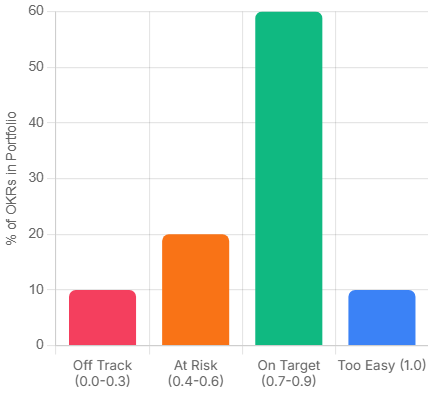
| Pro Tip: What each score band actually means 0.0 – 0.3: Off track. Something structural needs to change this week. 0.4 – 0.6: Progress, but at risk. Worth a focused conversation. 0.7 – 0.9: On target. The stretch is working. 1.0: Either the target was too conservative, or something exceptional happened. Worth understanding which. |
The monthly review
This is where you ask whether the Key Results are still the right ones. Circumstances shift mid-quarter. A Key Result that was meaningful in week one can become irrelevant by week five if the market moves, a client churns, or a product decision changes the team’s focus. Catching that at month two is useful. Catching it at the retrospective is just documentation.
The end-of-quarter retrospective
Score every Key Result honestly. Identify the gaps. The question is not ‘what went wrong’ but ‘what did we learn about how we set these.’ Most teams improve their Key Result quality significantly between cycle one and cycle three, simply by being honest in the retro about where the measurement was off.
3 OKR Mistakes That Quietly Kill the First Three Cycles
These are the patterns that appear most consistently in teams that start OKRs with genuine intention and still find themselves back at square one six months later.
Mistake 1: Writing Key Results that are tasks.
The creative agency story above is a clean version of this. But the same trap appears everywhere. ‘Launch the new onboarding sequence.’ ‘Complete the quarterly audit.’ ‘Deliver the revised pricing model.’ All tasks. None of them say anything about whether the work had any effect. Rewrite every Key Result by asking: what would change in the business if this went well? That change is the Key Result.
Mistake 2: Setting too many OKRs.
Three well-chosen OKRs that the team genuinely believes in will outperform eight every time. When the list gets long, prioritisation stops happening. People work across all of them moderately rather than driving hard on the ones that matter most. The number itself signals whether real choices were made in the planning session.
Mistake 3: Tying OKRs to performance reviews.
This one is usually a founder decision, not a manager decision. And it’s worth naming directly: if the team believes their OKR scores will affect compensation or job security, they will write safe targets. Not because they’re dishonest, but because no rational person sets ambitious targets when missing them is costly. The scoring system only produces useful data when people feel safe enough to be honest about where they actually are.
The Execution Gap: Where OKR Programmes Actually Break Down
There’s a pattern that shows up in teams six to eight weeks into their first OKR cycle. The Objectives were written well. The Key Results are genuine outcomes. The weekly check-in was agreed. And then, quietly, the updates stop.
Not because anyone decided to abandon the process. Because updating the OKR tracker feels like a second job on top of the actual work. The project delivery happens in one system. The OKR scores live in a spreadsheet nobody has bookmarked. By the time the quarterly retro arrives, the scores are being reconstructed from memory rather than tracked in real time.
This is the execution gap. OKRs tell you where to go. They don’t automatically connect to where the work is happening. And for most project and ops managers, that connection is the missing piece. Not a more sophisticated planning framework. Just a way to see, in the same place, whether the work being done is moving the numbers that matter.
If that gap sounds familiar, it’s worth looking at how your team manages the space between strategy and day-to-day delivery. Skarya is a work management platform built specifically for service teams and project-led businesses, and closing that gap is the problem it was designed around. If you’re running OKRs in one tab and your work in another, it’s worth a look.
OKR Implementation Is a Skill. It Gets Sharper Each Cycle.
The first OKR cycle is almost always imperfect. The Objectives are slightly too broad, one or two Key Results turn out to be tasks in disguise, and the cadence slips by week five. That’s not failure. That’s the normal shape of a first attempt.
What separates teams that get better from teams that quietly abandon the framework is the retrospective. Scoring honestly, naming what the measurement missed, and rewriting sharper Key Results for the next cycle is the whole compounding mechanism. Teams that do this consistently for three cycles end up with an OKR practice that genuinely reflects how the business moves.
Start with three Objectives. Write Key Results that would prove something changed, not just that something happened. Check in every week. Score honestly. The process is the product.
OKR FAQs: What Managers Ask After Running the First Cycle
Should company OKRs and team OKRs be written at the same time?
Ideally yes, and in that order. Company OKRs set the direction, then teams write their own OKRs to show how they’ll contribute. When this sequencing is reversed, or when they happen in parallel without coordination, team OKRs tend to drift toward what each function is already doing rather than what the business actually needs. A two-week lag between company and team OKR sessions is usually enough. More than a month and the connection weakens.
How do you handle a Key Result that becomes irrelevant mid-quarter?
Change it, document why, and treat the swap as signal for the next planning session. The rule is that you change it because the situation changed, not because you’re behind on it. If a product decision makes a Key Result obsolete by week four, replacing it is the right call. If you’re at 0.3 in week seven and the target feels uncomfortable, that’s not a reason to revise it. It’s a reason to have an honest conversation about what happened.
What is the right number of Key Results per Objective for an operations team?
Two to four, with three being the most common sweet spot in practice. Operations functions often have the instinct to measure everything, because ops work touches many parts of the business. Resist it. More Key Results means more things to update, more potential for contradiction between metrics, and less clarity about what actually matters. If four Key Results all seem essential, that usually means the Objective itself is too broad and needs to be split.
Can OKRs work for project-based work where deliverables vary every quarter?
Yes, but the Key Results need to measure delivery quality and client outcomes rather than project completion. ‘Deliver six projects on time’ is a weak Key Result for a project-led team. It measures throughput, not value. Stronger Key Results for project work tend to focus on client satisfaction scores, scope change rates, margin delivery, or repeat work rates. These stay meaningful across quarters even when the specific projects change.
How do you stop the weekly OKR check-in from becoming just another status meeting?
By changing the question. A status meeting asks What did you do this week.’ An OKR check-in asks, ‘Is the Key Result on track, and what is blocking it?’ The structure should be built around the score, not the activity. If a Key Result is at 0.6 and the conversation focuses on why, that’s an OKR check-in. If it becomes a round table of project updates, the format has drifted. A tight fifteen minutes with a shared scoring doc open is usually enough to keep it focused.
Leave a Reply