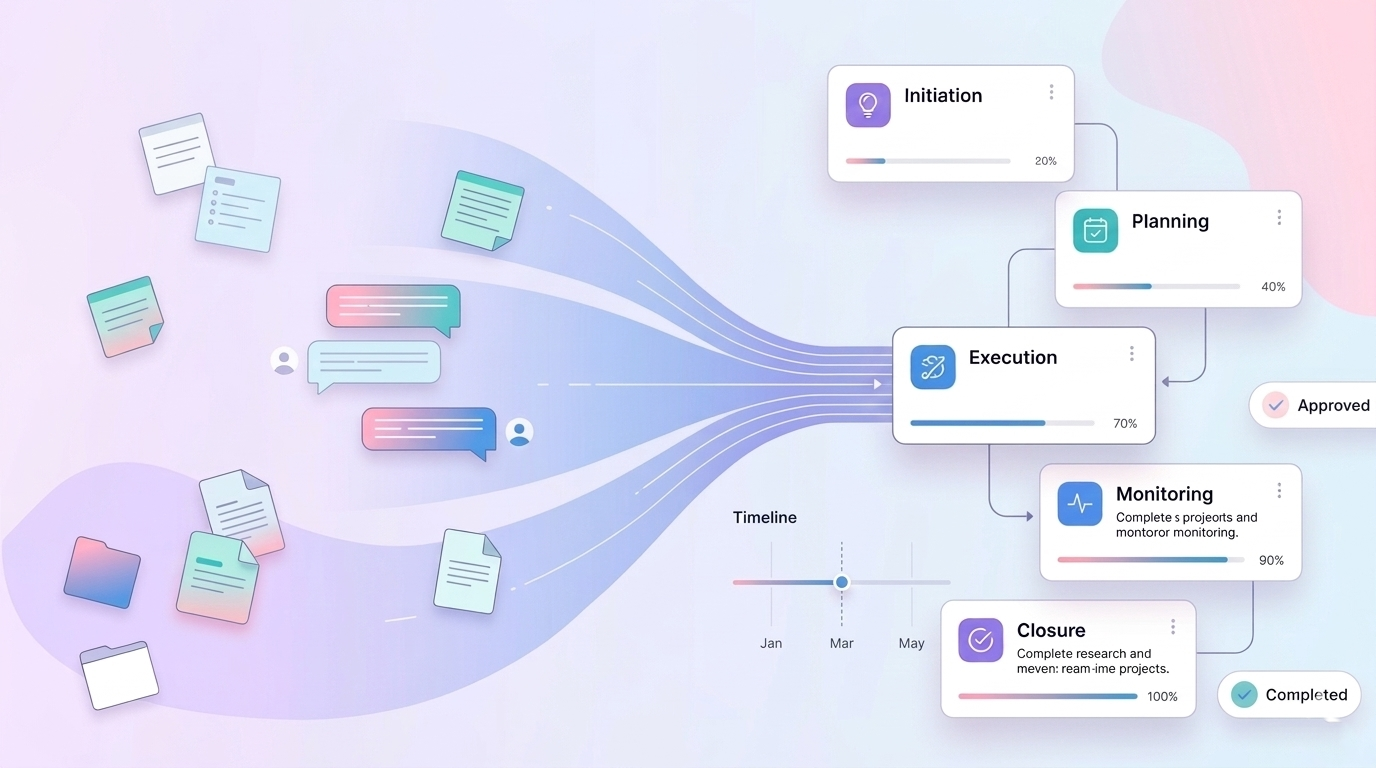
Most projects don’t die from lack of effort. They die from lack of clarity.
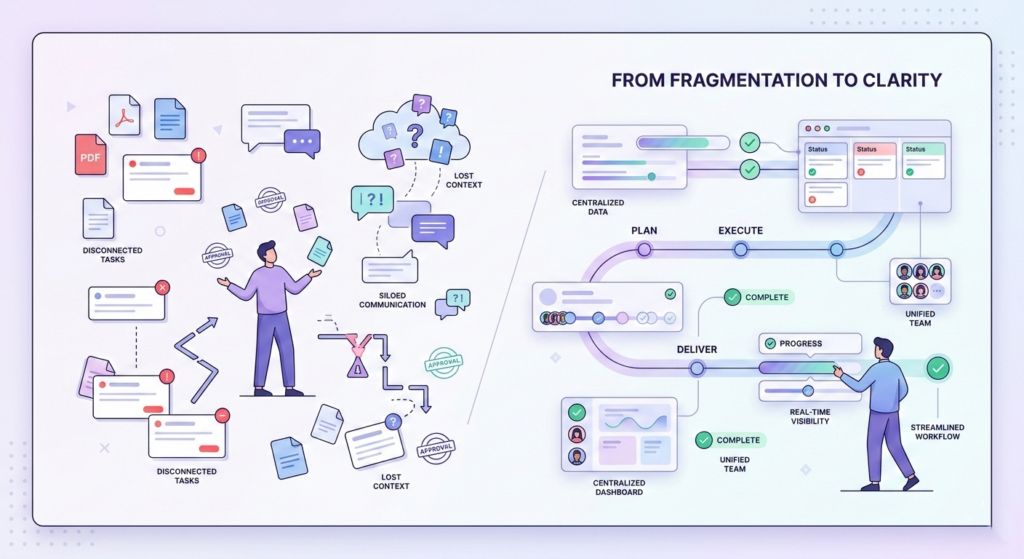
A request lands in Slack. The brief lives in Google Docs. Tasks are tracked in one tool, feedback arrives in another, and approvals happen somewhere over email. By the time the team tries to figure out where the project actually stands, they’re not managing work — they’re managing confusion.
That fragmentation is exactly what the five stages of project management are built to prevent. These phases don’t just organize tasks — they give every person on the team a shared understanding of where the work is, who owns what, and what needs to happen next.
In this guide, we’ll break down each stage, walk through a single real-world example from start to finish, and show how teams using Skarya move through the entire lifecycle with less friction and fewer unnecessary meetings.
What Are the 5 Stages of Project Management?
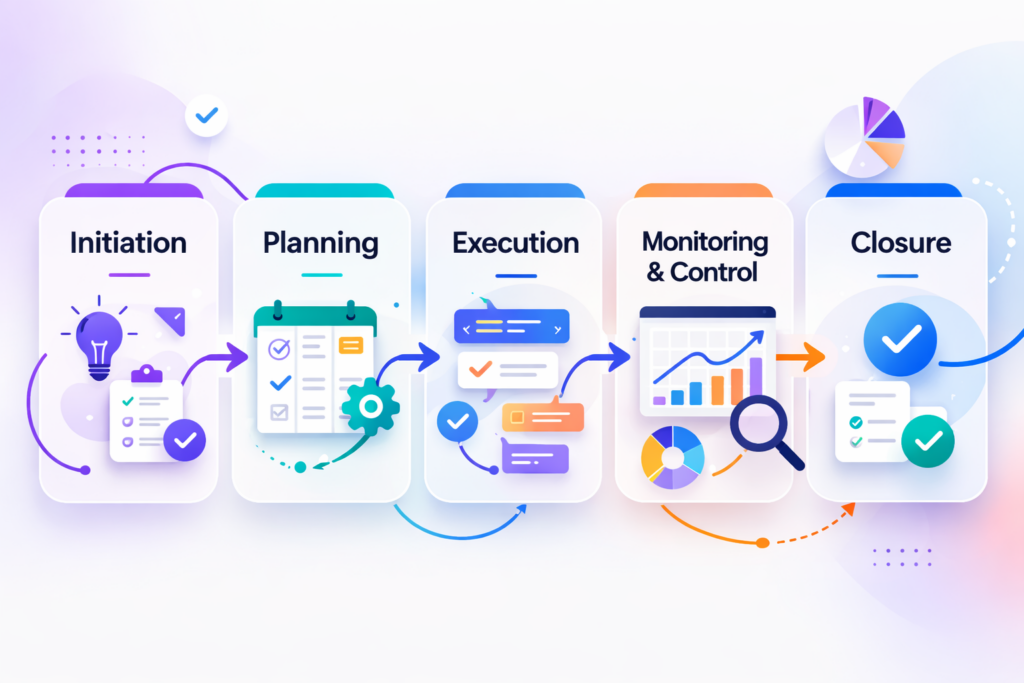
The five stages of project management drawn from the Project Management Institute (PMI) framework are:
- Initiation – define the goal and confirm the project should proceed
- Planning- build the roadmap: tasks, owners, timelines, and dependencies
- Execution — do the work, collaborate, and create deliverables
- Monitoring & Control track progress, spot issues early, and adjust
- Closure – confirm completion, hand over outputs, and capture learnings
Together, these phases form the full project management lifecycle. Teams that follow them deliver more predictably, waste less effort on rework, and spend less time asking each other for status updates.
Quick Reference: The 5 Stages at a Glance
| Stage | Purpose | Key Output |
| 1. Initiation | Define the goal; confirm the project should proceed | Project brief, stakeholder alignment |
| 2. Planning | Build the roadmap with tasks, owners, timelines, and dependencies | Project plan, milestones, RACI |
| 3. Execution | Do the work, collaborate, create deliverables | Completed deliverables, live collaboration |
| 4. Monitoring & Control | Track progress, manage risk, keep stakeholders informed | Status reports, updated plan |
| 5. Closure | Confirm completion, hand over, document learnings | Sign-off, lessons learned, archived assets |
Why Project Management Stages Matter More Than Most Teams Realize
A project is not a task list. It is a sequence of decisions, handoffs, approvals, and outcomes and when teams skip the structure, they encounter the same problems on every project:
- Scope that keeps expanding because nobody locked it down at the start
- Deadlines missed because dependencies were never mapped in planning
- Duplicated effort because ownership was never clearly assigned
- Approvals that stall execution because nobody defined the review process upfront
- Status meetings that exist only because progress is invisible
According to PMI’s Pulse of the Profession, organizations that undervalue project management report 67% more project failures than those with mature practices.
The stages don’t eliminate these problems — but they reduce how often they happen, and dramatically cut the cost when they do.
Following One Project Through All Five Stages
To make each stage concrete, we’ll follow the same example throughout this guide: a B2B SaaS company preparing to launch a new feature an AI-powered reporting dashboard. The project involves product marketing, design, content, and a dev team managing the release.
Watch how the stages shape every decision from kickoff to post-launch wrap.
Stage 1: Initiation Start with a Question, Not a Task
Most project failures are born here, in the initiation stage not in execution. This is the phase where the team defines the project’s purpose and determines whether to proceed. The goal isn’t to start building yet. The goal is to establish direction.
What Happens in the Initiation Stage
- Define the project goal and the business need it addresses
- Identify key stakeholders and understand their expectations
- Establish high-level success criteria
- Assess feasibility and surface early risks
- Decide whether to proceed, pause, or descope
The Most Expensive Mistake Happens Before Work Starts
The most common initiation failure is rushing through this phase to “start fast.” Teams skip alignment, assume a shared understanding that doesn’t exist, and pay for it throughout every stage that follows. Vague goals don’t become clear later they become arguments.
Running Example: Initiation
The product team requests a launch campaign for the new AI reporting dashboard. Without a proper initiation, marketing assumes the goal is awareness, while leadership expects qualified pipeline. Design starts creating social assets, content starts writing blog posts, and nobody is building the conversion-focused landing page that actually matters. That misalignment is born in initiation.
A strong initiation would surface this immediately: align on the goal (pipeline, not awareness), define the target audience (mid-market ops teams), and set the primary success metric (demo requests) before a single asset is created.
Stage 2: Planning — Build the Map Before You Start Moving
Planning is where direction becomes a deliverable roadmap. Once the team agrees on the goal, this stage defines how the work will happen, who owns it, and when it needs to be done.
This is also where most of the friction in execution gets either created or prevented.
What Happens in the Planning Stage
- Break the project into specific tasks and milestones
- Assign one clear owner for every workstream
- Set realistic deadlines and map dependencies
- Allocate resources and flag capacity constraints
- Define the review and approval workflow
- Document the communication plan – who needs what, and when
Good Planning Doesn’t Predict the Future, It Reduces Surprises
Teams that invest in planning spend less time in execution recovering from avoidable problems. But planning isn’t about perfect prediction — it’s about reducing uncertainty enough that the team can move with confidence instead of guesswork.
In Skarya, planning happens in the same place where work gets done, so briefs, tasks, owners, and timelines stay connected from the start rather than drifting into separate tools the moment execution begins.
Running Example: Planning
With the goal aligned, the team builds the launch plan: landing page copy (owned by content, due Week 1), page design (owned by design, depends on copy), dev handoff (depends on design approval), paid ads (owned by growth, due Week 2), and a launch blog post (owned by content, due Week 3). Approval checkpoints are mapped for each asset. Dependencies are visible. Everyone knows their lane.
Stage 3: Execution Where Plans Meet Reality
Execution is the most visible stage because it’s where things actually get made. Tasks move. Files get created. Teams collaborate. Deliverables take shape. It’s also where the quality of initiation and planning becomes immediately obvious, well scoped projects execute with momentum, poorly scoped ones execute in constant recovery mode.
What Happens in the Execution Stage
- Team members work on assigned tasks and update progress in real time
- Cross-functional collaboration happens across design, content, and dev
- Deliverables are created, reviewed, and revised based on feedback
- Blockers are flagged and escalated before they compound
- Decisions and context are captured alongside the work
The Biggest Execution Killer: Context Separated from Work
Execution breaks down when work and context live in different places. When the brief is in a doc, tasks are in a board, and feedback arrives in a thread, the team spends more time reconstructing the picture than actually moving the project forward.
Research from the Asana Work Index found that knowledge workers spend nearly 60% of their time on work about work status updates, searching for information, chasing approvals rather than the skilled work they were hired to do. That’s not a people problem. It’s a structural one.
Skarya keeps brief, tasks, comments, and status in one place so the team can work without constantly context-switching between tools.
Running Example: Execution
Content ships the landing page copy on time. Design picks it up and starts the layout. Growth begins building the ad sets in parallel. The dev team, however, is waiting on design approval before building the page in staging and that dependency isn’t visible to the project lead. Execution is moving, but a silent blocker is forming.
Stage 4: Monitoring and Control See Problems Before They Become Crises
Monitoring and control doesn’t start after execution — it runs alongside it. This is the stage where the team tracks what’s actually happening versus what was planned, and makes adjustments before a small slip becomes a missed launch date.
It is also the stage most teams do worst, not because they don’t care, but because their tools make genuine visibility hard.
What Happens in Monitoring and Control
- Track task and milestone completion against the original plan
- Review team workload and surface capacity risks early
- Identify blockers and escalate before they compound
- Communicate project status to stakeholders without relying on meetings
- Update the plan when reality diverges from the original roadmap
Visibility Delayed Is a Problem Doubled
The most common monitoring failure isn’t missed metrics, it’s stale information. When project status lives in a spreadsheet updated weekly, or surfaces only in a Friday standup, the team is always operating on yesterday’s reality. By the time an issue becomes visible, it’s already an emergency.
Real-time visibility tasks updating as work moves, blockers surfacing as they’re flagged is what separates teams that manage projects from teams that just react to them.
Running Example: Monitoring
With proper monitoring, the project lead sees that design approval is now two days late — which means the dev build is at risk, which means the launch date is at risk. Caught early, the lead can pull in a second designer or push the launch by three days. Caught on launch week, the options are much worse.
Without visibility, the team would only discover this at the Friday standup five days too late.
Stage 5: Closure- The Stage That Makes Every Future Project Better
Closure is the most skipped stage in project management, and the most consequential. Most teams mark the last task done and move on. But a project isn’t finished when work stops, it’s finished when outputs are handed over, learnings are captured, and the team has documented what they’d do differently next time.
Skipping closure means carrying the same inefficiencies, bottlenecks, and misalignments into every future project. Doing it well means each project makes the next one smarter.
What Happens in the Closure Stage
- Finalize all deliverables and obtain formal stakeholder sign-off
- Hand over project outputs to the relevant team or system
- Document lessons learned — what worked, what didn’t, what to change
- Archive project assets so they’re findable for future reference
- Confirm all open items are resolved or formally deferred
Closure Converts Delivery into Institutional Knowledge
Teams that close projects properly don’t just ship they compound. The approval workflow that caused this launch to stall gets fixed before the next one. The dependency that was discovered too late gets mapped earlier. The onboarding friction for the new designer gets documented and removed.
Running Example: Closure
The dashboard feature launches. Demo requests hit 140% of the target. In the closure review, the team notes three things: the design approval step was the critical bottleneck, ad copy should be written before design starts next time, and the dev handoff needs a staging QA checklist. All three go into the next launch plan. The second launch takes three days less than the first.
Real Projects Don’t Move in a Straight Line and That’s Fine
On paper, the five stages look sequential. In practice, they’re fluid. A project enters execution, then returns to planning because scope shifts. A deliverable reaches review, then goes back to execution after feedback. Monitoring surfaces a risk that rewrites the timeline.
This is not a failure of the framework. The value of project stages is not that they make work perfectly linear. It’s that they give every person on the team a shared mental model — so when things change, the team has a common language to discuss what’s happening and what needs to happen next.
Structure doesn’t limit how teams work. It defines how they recover.
Why Smart Teams Still Struggle with Project Stages
Even experienced teams know the stages. The failure usually isn’t knowledge — it’s tooling and habit. Here are the patterns that consistently break project execution across every industry:
Unclear project intake creates downstream chaos
When projects arrive without enough context, every downstream stage inherits that ambiguity. A structured intake process is one of the highest-leverage investments a team can make.
Scattered communication kills momentum
When updates, files, approvals, and decisions live in different tools, the team loses coherence fast. Clarity is replaced by constant status chasing.
Shared ownership is no ownership
If everyone is responsible, no one is. Every task, milestone, and stage gate needs one accountable owner.
Approval workflows defined too late
Most projects don’t stall in execution — they stall in review. Defining the approval process in planning, not after a bottleneck forms, keeps work moving.
Visibility that only appears in meetings
When project status is only known because someone reported it in a standup, teams are reactive by design. Monitoring should surface issues continuously, not weekly.
Five Habits That Make Project Stages Actually Work
Knowing the stages is table stakes. Here’s what separates teams that consistently deliver from teams that consistently scramble:
- Keep context close to the work. Brief, tasks, decisions, and files should live together. Context fragmentation is the root cause of most execution slowdowns.
- Make ownership unambiguous. One owner per task, milestone, and stage gate. Ambiguous ownership is where accountability goes to die.
- Standardize project intake. Build a repeatable process for how projects begin. Better inputs at initiation produce better outputs at every stage that follows.
- Review progress continuously, not just weekly. Real-time visibility lets the team address blockers before they compound. Waiting for Friday to discover a Thursday problem is a pattern worth breaking.
- Close projects with intention. A project is done when deliverables are handed over, stakeholders have signed off, and lessons are documented for next time.
Why the Stages Break Down in Practice (And What Skarya Does About It)
Most teams don’t struggle with project management because they don’t understand the stages. They struggle because each stage happens in a different place.
The request comes in through Slack. The brief lives in Google Docs. Tasks sit in a board. Feedback arrives in a thread. Approval comes in email. And every time someone asks ‘where are we on this?’ the team has to rebuild the picture from scratch.
That isn’t a workflow problem. It’s a structural problem — and it gets worse as teams grow, projects multiply, and the gap between ‘what was planned’ and ‘what’s actually happening’ becomes harder to close.
Skarya is built around a different premise: work, context, ownership, and progress should live together, not across six different tools. In practice, that means:
- Structured project intake so every project starts with a clear brief, not a vague message
- Task management with single-owner assignment, deadlines, and visual dependency tracking
- Real-time progress visibility so monitoring doesn’t require a meeting to discover
- Approval workflows built directly into the project, not bolted on over email
- Project closure templates that make documentation the path of least resistance
Teams using Skarya spend less time chasing status and more time doing the work that actually moves projects forward.
The Problem Isn’t Knowing the Stages. It’s Following Them.
If you asked any team whether they do initiation, planning, execution, monitoring, and closure, most would say yes. But ask them whether every project has a documented goal before work starts, whether every task has a single clear owner, whether blockers are visible in real time, and whether lessons get captured before the next project begins and the answer is usually more complicated.
The gap between knowing the stages and consistently executing them isn’t a training problem. It’s a tooling and visibility problem. When each stage happens in a different system, following the process requires constant discipline to override the chaos. When each stage happens in the same connected workspace, the process becomes the path of least resistance.
That’s the shift Skarya enables — not just a smarter way to manage tasks, but a connected environment where the full project lifecycle is visible, trackable, and repeatable from initiation to closure.
Ready to bring all five stages into one connected workspace? Start your free trial of Skarya today — no setup fees, no credit card required.
Final Thoughts: Structure Is the Competitive Advantage
The five stages of project management aren’t a bureaucratic checklist. They’re the operating model that separates teams who consistently deliver from teams who consistently scramble.
Initiation gives your project purpose. Planning gives it structure. Execution brings it to life. Monitoring keeps it honest. Closure makes it reusable.
But here’s what most project management guides leave out: the stages only work when they’re connected. When initiation happens in one tool, planning in another, and execution somewhere else entirely, the framework exists in theory but breaks down in practice.
The teams that deliver the best work aren’t the ones working the hardest — they’re the ones who never have to ask ‘wait, where are we on this?’ because the answer is always visible.
That’s what Skarya is built for. Not just better task management but a workspace where every stage of the project lifecycle is connected, visible, and built to scale with your team.
Frequently Asked Questions
What are the 5 stages of project management?
The five stages are: Initiation, Planning, Execution, Monitoring and Control, and Closure. These phases come from the PMI Project Management Body of Knowledge (PMBOK) and are used across industries and team sizes.
What is the most important stage of project management?
Each stage is critical, but initiation is often the most impactful because a poorly defined goal creates problems that compound through every phase that follows. A clear initiation saves hours at every subsequent stage.
Can project stages overlap?
Yes. Monitoring runs simultaneously with execution. Planning sometimes restarts mid-project when scope changes. The stages are a framework for clarity, not a rigid sequence real projects move between them fluidly.
What is the difference between monitoring and control in project management?
Monitoring is the act of tracking what’s happening progress, timelines, blockers. Control is the act of responding to that information, adjusting plans, reassigning resources, escalating risks. The two happen together and continuously throughout execution.
What tools help manage all five project stages?
The most effective tools keep work, context, ownership, and progress in one connected place rather than scattering each stage across separate apps. Skarya is purpose-built to support the full project lifecycle — from structured intake through closure.
Leave a Reply