
You did not start a business to chase status updates and rewrite the same brief three times. But if you run a small team in Australia, that is probably where a lot of your week goes.
Finding the best AI tool for small business owner operations is not about adding another app. It is about removing the friction that eats your day. In this guide, you will learn exactly what to look for, why most tools fall short, and how the Skarya.ai work management tool helps Australian SMBs turn incoming work into clear tasks, connected documentation, and real visibility without hiring a project manager or running endless meetings.
Why Australian SMBs Struggle with Work Management
Work lives in too many places
For most small businesses in Australia, work arrives from everywhere, a client email, a WhatsApp message, a Slack ping, a sticky note from a Friday meeting. Each channel has its own format, its own urgency, and its own risk of getting buried.
When requests live in inboxes and DMs rather than a shared system, two things happen: work gets dropped, and the loudest person wins. Neither is good for your business or your team.
The hidden cost of chasing updates
Australian Bureau of Statistics data consistently shows that small businesses cite admin burden as one of their top growth barriers. And the biggest chunk of that admin is not invoicing or compliance, it is the invisible work of figuring out what is happening, who owns it, and whether it is on track.
Every check-in message, every “just following up” email, and every unplanned stand-up is a symptom of a system that is not working. The right AI tool fixes the system, not just the symptom.
What Is an AI Work Management Tool (And Why It Beats Regular AI)?
Not all AI tools are the same. Here is a quick way to tell them apart:
- Chat AI (like ChatGPT or Claude): Great for writing, brainstorming, and answering questions. It does not manage your work, it helps you think.
- Automation tools (like Zapier): Move data between apps when a trigger fires. Useful, but not intelligent about context or ownership.
- AI work management tools (like Skarya.ai): Live inside your workflow. They help you capture, organise, assign, and track work, and use AI to reduce the manual effort of doing all of that.
If you want fewer dropped balls and less time spent on coordination, you need AI that operates inside the workflow, not beside it.
How to Choose the Best AI Tool for Small Business Owner Workflows
Use this checklist before you commit to any platform. It will save you from a tool that looks great in a demo and fails in week two.
1. Capture work the moment it arrives
Your intake will never come from one channel. The best AI tool for small business owner teams standardises how work enters the system, regardless of whether it comes from a client email, an internal request, or a compliance deadline. If every request has to be manually reformatted before it can become a task, you have already lost the efficiency gain.
2. Turn vague requests into structured tasks
Real-world work requests sound like: “Can you handle this today?” or “Client wants changes.” A strong AI tool helps shape those inputs into tasks your team can actually execute. The minimum a task needs:
- A clear definition of done
- An owner (and backup owner where relevant)
- A due date and priority
- Supporting context- links, files, client details, constraints
3. Keep SOPs and docs connected to execution
Most businesses have process documentation. Most teams cannot find it when they need it. When SOPs live in a shared drive and tasks live in a separate tool, the gap between intention and execution widens under pressure. Look for a tool that keeps your documented processes attached to the workflows they support.
4. Visibility without weekly status meetings
If you need a meeting to find out what is happening, your tool is not doing enough. Good visibility means:
- A live view of what is in progress, blocked, and overdue
- Workload distribution across your team
- Summaries that do not require manual input
5. Fast adoption for a small team
Complex tools punish small teams. A practical rule: if a new staff member needs a training deck and a week of hand-holding to use the tool daily, it is too heavy. The best AI tools for small businesses are opinionated enough to guide good habits and simple enough that adoption is not a project in itself.
Skarya.ai Work Management Tool: Built for How Small Businesses Actually Run
Most platforms bolt AI onto an existing task manager and call it intelligent. Skarya.ai takes a different approach, it is built around how work actually flows in small teams, where context gets lost across handoffs and documentation is always three steps behind execution.
One place for tasks, docs, and workflows
Skarya brings tasks, documentation, workflows, and collaboration into a single system. That means context stays attached to execution. When someone picks up a task, they can see the relevant SOPs, prior decisions, and client notes without switching tools or asking a colleague who already left for the day.
For Australian service businesses, agencies, consultants, bookkeepers, healthcare admin teams, this is the difference between consistent delivery and inconsistent delivery that depends on who is in the office.
Kobi-AI That Works Inside Your Workflow
Kobi is the AI assistant built into Skarya. It is not a chatbot you query separately. It operates inside the workflow to:
- Draft structured tasks from rough, incomplete inputs
- Summarise progress and updates without manual reporting
- Keep workflows and documentation aligned with what is actually happening
- Suggest next steps and flag when something looks blocked
That is the practical difference between AI that saves you time every week and AI that impresses you once in a demo.
Real Use Cases for Australian Service Businesses
Client work and approvals: Client requests arrive with missing details and moving deadlines. Skarya helps you capture every request consistently, assign it with clear ownership, and keep approvals visible so nothing stalls mid-project.
Internal operations: IT access, onboarding, equipment, policy questions, all the internal requests that normally land in someone’s inbox and disappear. Standardise intake, route to the right person, track to completion.
Weekly delivery planning: Many small teams run informal weekly sprints without calling them that. Skarya makes planning clean, assign the week, see the load, spot blockers before they become fires.
Billable time tracking: If you sell time, time tracking needs to connect to tasks. Skarya helps you see what is billable and what is internal overhead, protecting your margin without end-of-month chaos.
How to Roll Out Skarya in 7 Days (Without Overthinking It
You do not need a six-week implementation. You need one workflow running end to end. Here is how to get there in a week.
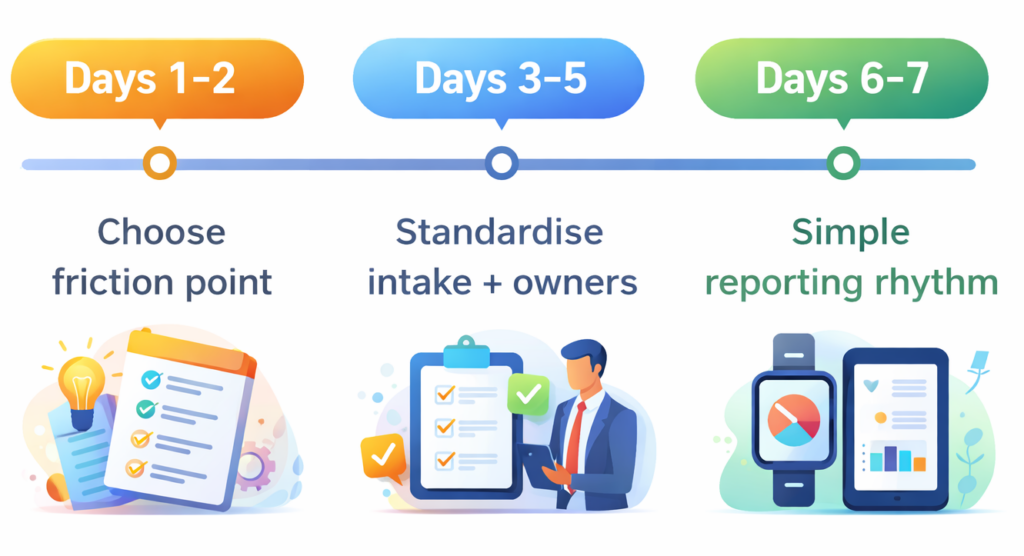
Days 1–2: Choose one friction point
Pick the workflow that causes the most daily pain. Client requests? Onboarding? Weekly delivery? Internal approvals? Start with exactly one. Getting one workflow working well is worth more than having five workflows set up badly.
Days 3–5: Standardise intake and ownership
Define the minimum information required to start work on that workflow. Set default owners. Add simple priority rules. Keep it lightweight, you will improve it based on real use, not imagined scenarios.
Days 6–7: Create a simple reporting rhythm
Run a short weekly review focused on three questions: What is blocked? What is overdue? What needs a decision? Use Skarya’s views and summaries to answer those questions without pulling people into a meeting. Once the rhythm is consistent, expand to the next workflow.
Frequently Asked Questions
What is the best AI tool for a small business owner in Australia?
The best AI tool depends on your biggest operational pain point. If your problem is work falling through the cracks, unclear ownership, and too much time chasing updates, an AI work management tool like Skarya.ai is the right category. It is purpose-built for small teams that need clarity without complexity.
Is Skarya.ai suitable for non-technical teams?
Yes. Skarya is designed for fast adoption by small, non-technical teams. You do not need a system administrator or a long onboarding process to get value from it.
How is Skarya different from tools like Asana or Monday?
Asana and Monday are task management platforms that have added some AI features. Skarya is built with AI at the core and specifically integrates tasks, documentation, and workflows into a single system, reducing tool switching and keeping context attached to execution.
Can I use Skarya.ai for client-facing work?
Yes. Skarya supports client delivery workflows, including task assignment, approvals, and status visibility. It is well-suited for agencies, consultants, and professional service firms.
How long does it take to get started?
Most small teams can have a core workflow running in one to two days. The 7-day rollout framework above gives you a practical path to getting started without overthinking the setup.
Stop Chasing Updates. Start Running a Better System.
The best AI tool for small business owners in Australia is not the one with the most features , it is the one your team actually uses every day. It captures work before it disappears, turns vague requests into clear tasks, keeps documentation connected to execution, and gives you visibility without constant meetings.
The Skarya.ai work management tool is built around that reality. It is practical, fast to adopt, and designed for small Australian teams that need to deliver consistently without adding complexity.
Ready to cut the admin and run a tighter operation? Start your free trial on Skarya.ai and get your first workflow running this week.
Leave a Reply